
Page
Chapter Three: Knowledge Module Three Governance and democracy
Completion requirements
Chapter Three: Knowledge Module Three
Governance and democracy
In this chapter
- The purpose of this module
- The learning outcomes of this module
- The components of this module
- The content under this module, which includes:
- Democracy — concepts, types, functioning, decision making, principles, decision making, indicators
- Electoral systems — types, the South African electoral system and role-players
- The South African government — the three tiers of powers, Chapter 9 institutions, National, Provincial and local government, how laws are made
- o Local government — Categories of municipalities, the legal and policy framework, citizen participation in local government
- Self-Assessment
Module Purpose
The main focus of the learning in this knowledge module is to build an understanding of democracy, the South African State and its law-making structures.
The learning will enable learners to demonstrate an understanding of:
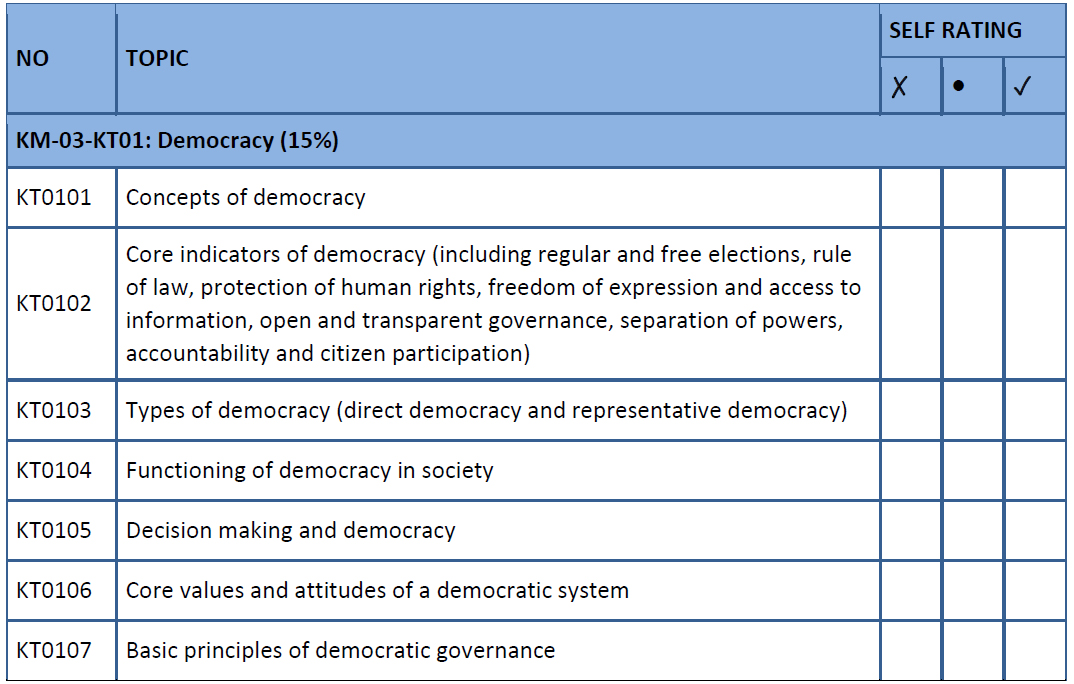
- KM-03-KT01: Democracy (15%)
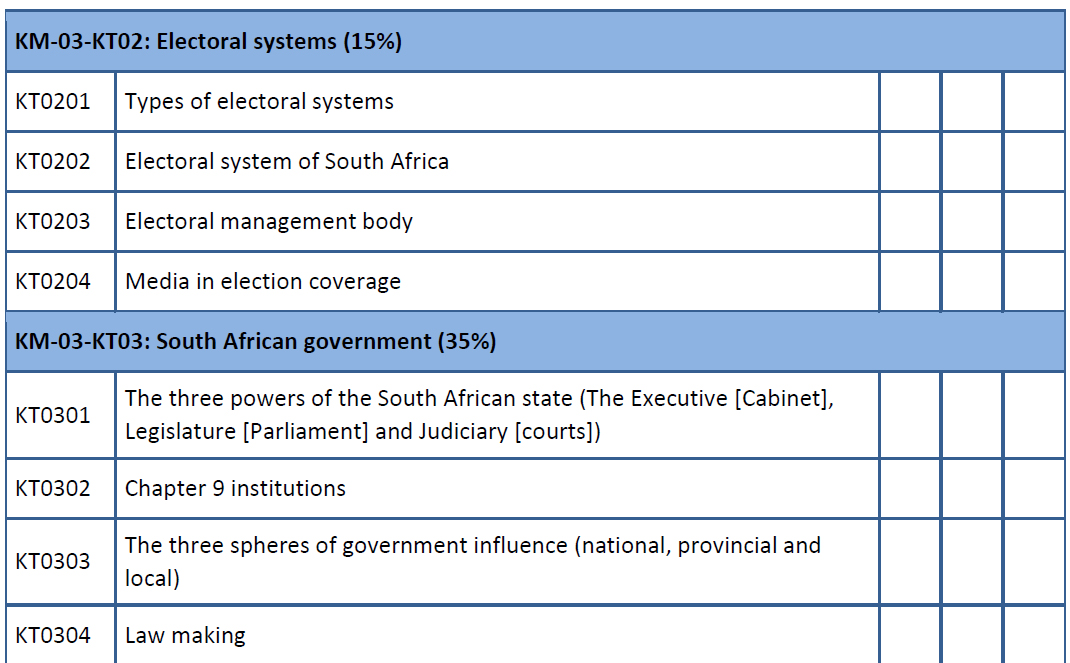
- KM-03-KT02: Electoral systems (15%)
- KM-03-KT03: South African government (35%)
- KM-03-KT04: Local government (35%)
Learning Outcomes:
The learning will enable you to demonstrate an understanding of:
- Democracy
- Electoral systems
- South African government
- Local government
Module Details
Module Content
Welcome to the third module of the occupational certificate in journalism. This module is focused on how democracy and government on national, provincial and local levels work in South Africa. It is important to know this for several reasons. First, journalists are part of the ecosystem of democracy and it is important to understand how journalists should play their role. Second, you need to understand how government works in South Africa to report on it adequately. There are different rules and regulations that apply to government in South Africa and we will discuss some of these. This module is divided into three topics — democracy, electoral systems, the South African government and local government.
Earlier in the course, we noted that journalism is essential for democracy. This section covers some basic facts about democracy. It looks at:
- The concepts that are important for democracy
- What are the indicators of democracy?
- What are the types of democracy?
- How democracy functions in society
- How decisions are made in a democracy
- What are the core values and attitudes of the democratic system?
- What are the basic principles of democratic governance?
This topic counts for 15% of this module.
Concepts of democracy
So, what do we mean by democracy? Democracy allows citizens to play a part in the social, political and economic life of the country. It should result in a government that represents the needs and interests of the majority of the people on local, provincial and national levels. It should also mean that the government at all levels is accountable to the people.
The word democracy comes from the Greek language from the words demos, which means ‘the people’ and kratein, which means ‘to rule’, making “the people rule”. There are different ideas about what democracy means. The dictionary18 defines democracy as:
1a : government by the people especially: rule of the majority
b : a government in which the supreme power is vested in the people and exercised by them directly or indirectly through a system of representation usually involving periodically held free elections
This means that everybody should have a say in how they are ruled. In most democracies today, people do not have direct political power. Direct democracy would mean that every single person could potentially have input on the issues that impact them. Most people consider this impractical. In South Africa we have a system of representative democracy, in that we vote in representatives who are to champion our interests based on what they have said about their policy positions before the election. In South Africa, elections are held every five years.
The three golden rules for a democracy are:
- There is a voting system;
- Citizens have freedom of speech; and
- Those who break the law get a fair trial.
In South Africa, democracy is enshrined in the Constitution. It reads:
“We, the people of South Africa,
Recognise the injustices of our past;
Honour those who suffered for justice and freedom in our land;
Respect those who have worked to build and develop our country; and
Believe that South Africa belongs to all who live in it, united in our diversity.”
- From the Preamble to the Constitution of South Africa
The Constitution of the Republic of South Africa, Act 108 of 1996, was the result of long and inclusive negotiations. The Constitution and the Bill of Rights are widely regarded as among the most progressive in the world. Chapter 2 of the Constitution deals with human rights – including freedom of speech, which is critical to both media practice and democracy.

Types of democracy
Broadly speaking, there are two types of democracy. A participatory democracy is when citizens have a direct stay in the formulation of laws and issues that affect them. A representative democracy is one in which citizens vote for representatives who then represent their interests in deciding on laws.
Functioning of democracy in society
The principle behind democracy is that people are best placed to make decisions on issues that affect them.
All systems of democracy share the same basic principles. It functions so that:
- The people elect the government.
- The government respects and represents the interests of the people.
- And all people (men, women and children) living with in democratic countries have rights that are codified and protected by the state.
- The people can complain about their government, question their government and join political parties that want to change their government.
- The people are equal before the law. There is no one above the law.
- People have the right to freedom of speech, religion, and children have the right to education.
Assignment 03
Decision making and democracy
People in representative democracies make decisions through the people that they elect. Decisions are codified into laws that act to guide further decisions in a country — both those by parliament (as is the system in South Africa) and those by judges. These systems ensure that people in power cannot make unilateral decisions on issues that impact some groups or even all people within a country. Governments are also accountable to each other through international law for what happens within a country. International law recognises the role of democracy in protecting and promoting human rights. Countries sign treaties based on what they would like to see happen in a country, related to human development, human rights and democracy.
Core values and attitudes of a democratic system
Democracy needs, and is reliant on, freedom of expression and access to information. People need access to information to make informed decisions. They also need the right to hold and express opinions, including political ones. It requires that all people are accountable for their actions in line with the law. All people should also be equal before the law. All people should have their human rights upheld, including their right to dignity and respect.
Basic principles of democratic governance
The basic principles of democracy are that people:
- Have a right to have a say in what happens in their country
- Are equal
- Have the right to hold political, religious and other views
- People have the right to hold the powerful to account
- Have the right to information about what publicly elected officials are doing
- Have the right to participate in the economy
Core indicators of democracy
How democratic a country is can be assessed by the existence of these indicators:
- Regular and free elections
- Rule of law – Nobody in a country can make arbitrary decisions, not even the president or ruling party members
- Protection of human rights — every person is equal, and nobody may discriminate against another
- Freedom of expression and access to information
- Open and transparent governance — the people have access to parliamentary processes and documents
- Separation of powers — the division of government responsibilities between the executive, legislative and judicial branches of government limit the power of each branch.

Electoral systems
Electoral system of South Africa
Elections in South Africa are facilitated by the Independent Electoral Commission.
National and provincial elections happen every five years. They make use of a proportional representation system in conjunction with a party list system. In this system, all votes count. The total number of votes for each party dictates the number of seats that party receives in parliament.
During a general election, national and provincial legislatures are elected. Voters get two ballots and cast their votes for their chosen party to the national and provincial government levels. This means that citizens have the option to vote for one party on national level and another on provincial. Each party decides which candidates they will submit for national and provincial structures, citizens do not vote for individuals. Once the votes have been counted, the party lists are used to fill the seats. People who are higher on the party lists are more likely to get a seat than those who are lower down.
Municipal or local government elections also take place every five years. They use a mixed or hybrid system making use of the ward system and proportional representation. There are three kinds of municipal councils in South Africa Metropolitan councils, local councils and district councils.
Electoral management body
This is:
an organisation or body that has the sole purpose of, and is legally responsible for, managing some or all of the elements that are essential for the conduct of elections and direct democracy instruments—such as referendums, citizens’ initiatives and recall votes—if those are part of the legal framework. These essential (or core) elements include:
determining who is eligible to vote;
receiving and validating the nominations of electoral participants (for elections, political parties and/or candidates);
conducting polling;
counting the votes; and
tabulating the votes.
In South Africa, the role is filled by the Independent Electoral Commission (IEC). The IEC is:
a permanent body created by the Constitution to manage free and fair elections at all levels of government.
It is independent, but publicly funded and accountable to parliament. According to Section 190 of the Constitution of the Republic of South Africa:
(1) The Electoral Commission must—
(a) manage elections of national, provincial and municipal legislative bodies in accordance with national legislation;
(b) ensure that those elections are free and fair; and
(c) declare the results of those elections within a period that must be prescribed by national legislation and that is as short as reasonably possible.
Section 5 of the Electoral Commission Act (51 of 1996) details the functions of the IEC. They are to:
(a) manage any election;
(b) ensure that any election is free and fair;
(c) promote conditions conducive to free and fair elections;
(d) promote knowledge of sound and democratic electoral processes;
(e) compile and maintain voters' rolls by means of a system of registering of eligible voters by utilising data available from government sources and
(f) information furnished by voters; compile and maintain a register of par-ties;
(g) establish and maintain liaison and co-operation with parties;
undertake and promote research into electoral matters;
(i) develop and promote the development of electoral expertise and technology in all spheres of government;
(j) continuously review electoral legislation and proposed electoral legislation, and to make recommendations in connection therewith;
(k) promote voter education;
(l) promote co-operation with and between persons, institutions, governments and administrations for the achievement of its objects;
(m) demarcate wards in the local sphere of government or to cause them to be demarcated;
declare the results of elections for national, provincial and municipal legislative bodies within seven days after such elections;
(o) adjudicate disputes which may arise from the organisation, administration or conducting of elections and which are of an administrative nature; and
(p) appoint appropriate public administrations in any sphere of government to conduct elections when necessary.
The IEC must ensure South African elections are credible. Credible elections should be:
- Inclusive – all citizens can participate
- Transparent – election activities are open to scrutiny and bodies can independently verify the process
- Accountable – there must be remedies in place for violations of citizens’ democratic rights
- Competitive – it must be possible for people to register political parties, appear on ballots and campaign

Media in election coverage
Elections can present challenges for the media. Many broadcasters have additional regulatory requirements before, during and after the elections. It is important that journalists are aware of these. There is also a heightened need to be balanced and fair, as bias during this time can be particularly harmful for the credibility of the media. The importance of the media during this period cannot be overstated. Media can impact voter turnout by encouraging people to vote or by reportage that undermines citizens’ trust in the system.
There are lots of opportunities around elections to provide practical information to voters. Media should provide information on:
- Voting education, including who can run for office and the role of the electoral commission
- Voter registration — where, when and how to register
- What happens on election day, how to cast ballots
- The counting of votes and the announcement of results
- What election observers and civil society organisations say about the election
It is also important to cover the manifestos and campaigning of all parties. Journalists should be allowed access to all parties and candidates and should make an effort to cover all parties, even if this may prove to be challenging. Journalists should be careful about accepting incentives to cover some parties disproportionately.
The media must cover statements of candidates even if they are discriminatory or defamatory, however this should be done critically rather than sensationally. It is important to balance such statements with a response from those impugned or researchers who know about issues. For example, politicians all over the world may use xenophobic sentiments during elections to scapegoat and attempt to get votes, these sentiments may not be backed up by evidence.
In covering the election, media should keep the needs of the citizens in mind and not get carried away covering the war of words between politicians.
As tensions can run high during elections, journalists should be careful and ensure that they remain safe.

The South African government
South Africa is a constitutional democracy with a three-tier system of government and an independent judiciary. The national, provincial and local levels of government all have legislative and executive authority in their own spheres and these levels are defined in the Constitution as "distinctive, interdependent and interrelated". This section addresses:
- The three powers of the South African State (The Executive, Legislature and Judiciary)
- Chapter 9 Institutions
- The three spheres of government influence (national, provincial and local)
- How laws are made
This section counts 35% of the module.
The South African government is divided into three parts: the Executive (the Cabinet), the Legislature (Parliament), and Judiciary (the courts) — each with its own functions and responsibilities. South Africa has national elections every five years to choose members of parliament who, in turn, choose a president from the winning party. The new president then chooses his/her Cabinet.
The Executive: Cabinet
The Executive is responsible for ruling the country through different departments or ministries headed by a member of Cabinet called a minister. The Cabinet is made up of the president, deputy president and the ministers.
The Legislature
To legislate means to ‘make laws’. The legislature, or Parliament, is where elected representatives, the members of Parliament (MPs) meet to discuss matters and decide on new laws. The word Parliament comes from the French word for "to speak". The people of South Africa can go to the public gallery and listen to the debate but they may not take part in the discussions.
Parliament is made up of two groups, the National Assembly and the National Council of Provinces (NCOP). The National Assembly is made up of all the Members of Parliament (MP’s) who got seats in the general elections. There are 350 – 400 MPs in our National Assembly. The head of the National Assembly is called the Speaker. It is the Assembly’s job to represent the public and to make sure the democratic laws of the Constitution are kept. They also have to check that the Cabinet does its job and does not go against the Constitution.
Legislative authority is vested in Parliament, which is situated in Cape Town and consists of two houses, the National Assembly and the National Council of Provinces. Parliament is bound by the Constitution and must act within its limits. Website http://www.parliament.gov.za
National Assembly
The National Assembly is elected to represent the people and to ensure government by the people under the Constitution. It does this by:
- choosing the President
- providing a national forum for public debate of important issues
- passing laws
- overseeing the executive
The National Assembly must consist of between 350 and 400 members, elected every five years by citizens who are 18 years or older and who are registered on the national voters roll. The Assembly currently has 400 members.
The number of seats each party holds is, in general, proportional to the number of votes each won in the last election. Half of the members of the Assembly come from the national lists of the parties, and the other 200 from their regional lists. This does not affect the number of seats each party holds — rather it affects which individual candidates take up the seats on behalf of their parties.
Parties hold the seats in Parliament, not individual members. To become eligible for membership, a person must, therefore, be nominated by a political party. If a member of the National Assembly dies, resigns or is expelled from the party, the party which holds that seat chooses another party member to represent it.
Officials
The National Assembly chooses presiding officers — the Speaker and the Deputy Speaker – from amongst its members at its first sitting. These officers act as 'referees', presiding over meetings of the
National Assembly and taking charge of debates to make sure that MPs can participate freely while keeping to the rules. The Speaker also has managerial duties to ensure that Parliament runs smoothly. Each political party in the Assembly elects a chief whip to run its affairs. The presiding officers, the chief whips and the leader of government business (the person appointed by the Cabinet to liaise with Parliament) together decide on the programme of work.
National Assembly and National Executive
The National Assembly chooses the President – head of the national executive – from amongst its members. The President forms the government by appointing the Cabinet. The Assembly has the power to remove the President in cases of serious misconduct or if the President is unable to perform the functions of the office. If the Assembly passes a motion of no confidence in the Cabinet (excluding the President) the President must reconstitute the Cabinet. If the Assembly passes a motion of no confidence in the President, the President and the Cabinet must resign. A state of emergency may only be passed by an Act of Parliament, and it may only be renewed if the National Assembly agrees.
Decision-Making in the National Assembly
A majority of votes are required for most decisions of the National Assembly. A vote on most bills may be taken if a majority of members are present, and a vote on other questions may be taken if a third of the members are present. Amendments to the Constitution require stronger majorities.
Making Laws
The National Assembly may make laws on anything except matters on which only the province may make laws (listed in Schedule 5 of the Constitution), it may amend the Constitution, and it may give its lawmaking powers (except the power to amend the Constitution) to another legislative body. In exceptional circumstances, the National Assembly may act with the NCOP to make laws even on matters listed in Schedule 5. The National Assembly may consider, pass, amend or reject any legislation brought before it, and may initiate or prepare any law, except a money bill (one to do with finance). Most of this work is done in committees before the bill is referred to a sitting of the Assembly for debate and for a vote on whether to accept or reject the bill.
Laws set out through Parliament are called statutory laws. The term is used to define written laws that are “regulatory or administrative laws that are passed by executive agencies.”24 They must align to the Constitution.
Portfolio Committees
The National Assembly's committees are called portfolio committees, for example, the Portfolio Committee on Education. Each committee oversees the work of a government department, debates and amends bills, and organises public hearings if an issue is of great public interest. Committees may also initiate bills. In the course of their oversight work, committees may summon any person to give evidence or to produce documents, and they can require any person or institution to report to them. Once a bill has been debated and amended in a committee, it is submitted to the Assembly for a vote.
Debates and Questions
Issues of national importance are debated in the National Assembly. Also, members of the Assembly may question Cabinet ministers.
The Budget
The annual budget is debated in the National Assembly and a vote is taken. At the beginning of every year, the Minister of Finance tables the budget. There are two budget bills: one that divides the money between national, provincial and local government (the division of revenue bill) and another that states how the national government will spend its money. The NCOP debates the budget and votes on it, and it must be involved in the final decision about the division of revenue.
National Council of Provinces
The National Council of Provinces (NCOP) represents the provinces to ensure that provincial interests are taken into account in the national sphere of government. It does this mainly by participating in the national legislative process, and by providing a national forum for public debate of important issues affecting the provinces. The NCOP also ensures that local government concerns are represented at the highest level.
The NCOP consists of nine provincial delegations nominated by the provincial legislatures and a delegation from the South African Local Government Association (SALGA). Each provincial delegation has 10 members made up of:
- four special delegates, drawn from the provincial legislature, including the Premier of the province or a person designated by the Premier as head of the delegation. These delegates may change from time to time
- six permanent delegates
This means every province is equally represented in the NCOP. The political parties in each provincial legislature are entitled to be proportionally represented in that province's NCOP delegation. The SALGA delegation comes from the nine provincial local government associations to represent local government, but it may not vote.
Political parties hold the seats in the NCOP, not individuals. If a member of the NCOP resigns, dies or is expelled from the party, the party that holds that seat chooses another party member to take up the seat. The party's choice has to be ratified by the relevant provincial legislature.
NCOP office bearers
The NCOP elects presiding officers from amongst its members – a chairperson and two deputy Chairpersons. These officers manage the work of the NCOP and preside over debates, making sure that delegates can speak freely while remaining within the rules. The permanent deputy chairperson is elected for five years while provincial premiers take turns to be rotating deputy chairpersons for a year. A provincial whip organises the work of each provincial delegation. Parties with at least seven permanent delegates, and who do not have members functioning as provincial whips, are also entitled to a party whip. A programming whip helps the Chief Whip schedule the work of the NCOP.
Decisions
Each provincial delegation has one vote that is cast on behalf of the province by the head of its delegation. Questions before the NCOP are decided when five provincial delegations vote in favour, but amendments to the Constitution require the approval of six delegations. In NCOP votes on ordinary bills not affecting the provinces, each delegate has a vote, a third of delegates must be present, and the decision is taken by a majority of those present.
Lawmaking Role
The NCOP considers, passes, amends, proposes amendments to, or rejects legislation. It must consider all national bills. It may also initiate or prepare bills falling within Schedule 4 of the Constitution (matters over which national and provincial legislatures jointly have the power to make laws) and certain bills affecting the provinces. However, only the Minister of Finance may introduce a bill to do with finance. Most of this lawmaking work is done in committees, but all bills must be referred to a sitting of the NCOP for debate and for a vote on whether to accept or reject the bill.
Debates and Questions
Issues of provincial importance are debated in the national forum of the NCOP. Members may ask Cabinet ministers questions which must be answered in the NCOP. The NCOP may require a member of the Cabinet, a deputy minister or an executive official in the national or provincial government to attend a meeting or committee meeting. A verbatim (word for word) record of all debates and questions is published in the parliamentary publication Hansard (see https://www.parliament.gov.za/hansard).
Committees
The NCOP's committees are called select committees, for example, the Select Committee on Housing, Public Works and Transport. Each committee shadows the work of some government departments, debates and amends bills, and organises public hearings if an issue is of great public interest. Committees may summon any person to give evidence or to produce documents, and they may require any person or institution to report to them. Once a bill has been debated by a committee, it is submitted to the NCOP for a vote.
Oversight of the Executive
The NCOP has oversight of the executive within its role as the representative of the provinces. In certain situations, the national executive may intervene in the affairs of a province, and a provincial executive may intervene in the affairs of a local authority. Interventions like these must be approved by the NCOP, and they must be regularly reviewed by the NCOP. A national government decision to stop the transfer of funds to a province must be approved by both houses of Parliament. Provinces have certain executive powers under the Constitution, as long as they have the capacity to do what needs to be done. The NCOP must resolve any dispute between the national and provincial government over the capacity of a province to do this work. Both houses of Parliament must approve the declaration of a state of national defense.
Judiciary – The Courts
The Judiciary is the court system. This is the part of government that has to make sure that those who do not obey the law are punished. There are different levels of courts. If a case in a low court is appealed, it goes to a higher court. The decision of the higher court can be different and can overrule the decision of the lower court.
The two highest courts in South Africa are the Constitutional Court and the Supreme Court of Appeal. The Constitutional Court has the final say on matters that have to do with the Constitution. If Parliament wants to make a new law, the Constitutional Court first has to make sure that it does not go against the Constitution. The Supreme Court of Appeal has the highest say in all other court matters. The court system is independent of the rest of government. After an election, Parliament and the Cabinet can change, but the courts should still look the same. In other words, the elections do not influence the Judiciary.
The Judiciary may be part of government but operates without being influenced or pressurised by government (at any level). The independence of the Judiciary is a cornerstone of a constitutional democracy. It guarantees the supremacy of the Constitution. The Judiciary is not formally part of the policy-making or implementation machinery of government, but court findings influence how the law is interpreted25.
In cases, where the law is not enacted through a legislature, it is retrieved from decisions made by a judge through prior court decisions, judges or administrative rulings26. These decisions are made based on statutory law to clarify issues where disagreement could arise. This is called case law or common law.
The diagram below reflects the hierarchy of law in South Africa. Statutory law (Acts) should align to the constitution, which is the highest law in the land. Common or case law reflects the interpretation of statutory law or the Constitution. In other words, even when there is no statutory law (or Act) for a particular issue, courts can create law through interpreting the Constitution and related statutory law.
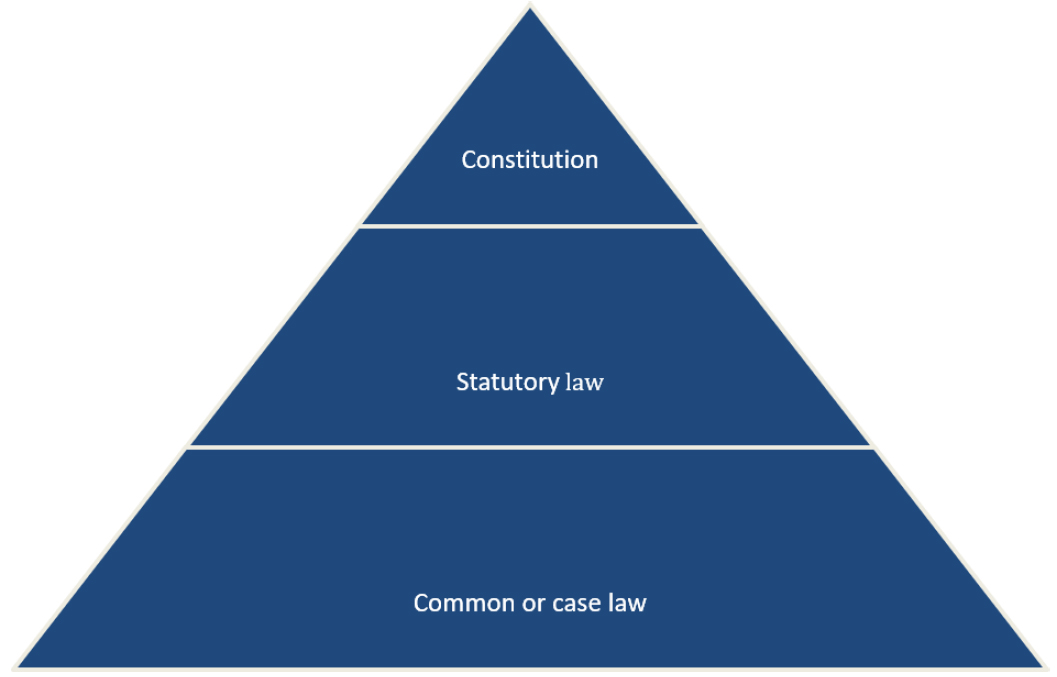
Of course, in reality the picture is far more complicated, as case law may serve to align, in its interpretation statutory law to the Constitution. But the diagram may help you to get a general picture of how law works and how courts rule on issues. You’ll notice from court rulings that judges refer to other rulings in interpreting the law and so ground their rulings in what is called ‘precedent’.
Mechanisms and role-players that facilitate media access to the state officials
Government Communication and Information System (GCIS) is tasked with fostering transparency by providing the public with timely, accurate and accessible information. It was established in 1998 after a task group found that government communication had some notable gaps in government communication. Under the GCIS there is a directorate of media engagement, which is tasked with providing government information to the media. They also have a parliamentary liaison service to promote access to members of parliament. GCIS oversee the South African government News Agency – www.sanews.gov.za.
A government contact directory is provided for government personal on national, provincial and local levels (including independent constitutional bodies), as well as for state-owned enterprises (SOEs) and community information and service centers on https://www.gov.za/about-government/contact-directory. Also included are representatives (such as consulates and embassies) of other countries in South Africa, media contacts, miscellaneous organizations including legal libraries, tourism authorities, foundations and development organizations.
Chapter 9 Institutions
The three spheres of government
Government has the responsibility to make policies and laws about the rights and responsibilities of citizens and the delivery of government services. Government collects revenue (income) from taxes and uses this money to provide services and infrastructure that improves the lives of all the people in the country.
The Constitution of South Africa sets the rules for how government works. There are three spheres of government in South Africa:
- National government
- Provincial government
- Local government
The spheres of government are autonomous (they function independently) and should not be seen as hierarchical (for instance, national government is not in charge of local government). Each sphere plays their role. The Constitution says:
The spheres of government are distinctive, inter-related and inter-dependent. At the same time they all operate according to the Constitution and laws and policies made by national Parliament.
The government machinery is made up of three parts (as discussed before), as a reminder:
- The elected members (legislatures) — who represent the public, approve policies and laws and monitor the work of the executive and departments.
- The Cabinet or Executive committee (executive) — who co-ordinate the making of policies and laws and oversee implementation by the government departments
- The departments and public servants — who are responsible for doing the work of government and account to the Executive.
- This is applicable to all spheres, shown in the table below:

National government
The national government consists of all the departments of government. It is where the executive and legislative arms of government rest.
Laws and policies are approved by Parliament which is made up of the National Assembly and the National Council of Provinces (NCOP). The National Assembly is made up of members of Parliament, elected every five years (as described above).
The NCOP functions to ensure that provincial and local government are directly represented in Parliament. It is made up of representatives of provincial legislatures and local government. Each province has a set number of permanent and rotating representatives. The NCOP has to debate and vote on any law or policy that affects provincial or local government.
The President is elected by Parliament and appoints a Cabinet of ministers. They act as the executive committee of government and each minister is the political head of a government department.
Each government department is responsible for implementing the laws and policies decided on by Parliament or the Cabinet. Government departments are headed by a director general and employ directors (managers) and public servants (staff) to do the work of government.
Every department prepares a budget for its work. The budgets are put into one national budget by the Treasury (Department of Finance), which has to be approved by Parliament. The Treasury has to balance the income and expenditure of government in the budget and will rarely give departments everything they ask for.
The Presidency coordinates the work of government and provides direction and strategic support to ministers and departments. The Presidency monitors and evaluates overall progress towards achieving government goals.
The Department of Public Service and Administration (DPSA) sets the policies and framework for the Public Service at national and provincial level.
Some departments only exist at national level because they deal with issues that concern the whole country. Examples are Defence, Foreign Affairs, Water and Forestry, Science and Technology, Trade and Industry, Mineral and Energy, Public Enterprises, Home Affairs and Public Service and Administration.
Other departments have national and provincial departments because they deal with direct provincial service delivery. Examples are Education, Housing, Health and Social Development.
Provincial or local government may not do anything that is against the laws or policies set down by national government. Provincial government gets most of its money from the national government through Treasury. Local government also gets grants and some loans through the Treasury.
The Department of Provincial and Local Government (which resides at the national level) is responsible for national co-ordination of provinces and municipalities. In every province, the provincial departments of local government monitors and supports municipalities.
South Africa has nine provinces: Eastern Cape, Free State, Gauteng, KwaZulu-Natal, Limpopo Province, Mpumalanga, Northern Cape, North West and Western Cape. Each province has its own provincial government, with legislative power vested in a provincial legislature and executive power vested in a provincial premier and exercised together with the other members of a provincial executive council.
There are nine provincial governments. Every province has a legislature made up of between 30 and 90 members of the Provincial Legislature (MPLs). Some provincial laws are approved by legislatures. The legislature also passes a provincial budget every year. Legislatures are elected in provincial elections that are held with national elections, every five years.
A Premier is elected by the legislature and appoints Members of the Executive Council (MECs) to be the political heads of each provincial department. The MECs and the premier form the Provincial Executive Council (Cabinet).
Provincial government is headed by a director general and provincial departments are headed by a deputy director general or a dead of department. They employ directors (managers) and public servants to do the work of government. Most of the public servants in the country fall under provincial government — these include teachers and nurses.
In each of the nine provinces there are usually at least 12 departments. The names are slightly different and, in some provinces, departments are combined.
Some of them are:
- Finance
- Economic development
- Tourism
- Housing
- Education
- Health
- Social Development
- Transport
- Public works
- Planning and Environment
- Sport, recreation, art and culture
- Agriculture
- Local government
- Safety and security or Community Safety
The provincial MEC and Department of Local Government are responsible for co-ordination, monitoring and support of municipalities in each province.
Local government
Municipalities run local affairs subject to national and provincial legislation, but the latter may not compromise or impede a municipality's right to exercise its powers or perform its functions.
More information about local government appears under the local government section below. The topic of local government accounts for a considerable proportion of the content of this module.
More information about local government appears under the local government section below. The topic of local government accounts for a considerable proportion of the content of this module.
Assignment 15
Lawmaking
Lawmaking tends to follow a standard process.
- A green paper discussion document is drafted by the executive branch of government, for example, the Department of Social Development. Often this green paper is to address a gap in the law created by an international commitment or to actualise a constitutional right.
- After review and input from interested parties, such as civil society organisations, a white paper position document is drafted
- The white paper is approved by Parliament
- A draft Bill is then drafted, tabled and refined by Committee. Interested parties again have the opportunity to provide input
- Finally, an Act is passed based on the final bill
Local government
Municipalities run local affairs subject to national and provincial legislation, but the latter may not compromise or impede a municipality's right to exercise its powers or perform its functions.
In line with the principles of co-operative government, the national and provincial government must support and strengthen municipalities' capacity to manage their own affairs.
Accountability of local government is strengthened through the provision that legislation passed by the higher bodies must be published before being introduced to allow local interests the opportunity to make representations. The South African Local Government Association (SALGA) has a mandate to transform local government and to represent its interests at provincial and national levels.
Members of municipal councils are elected every four years on the basis of the relevant portion of the national common voters' roll. South Africa has 284 municipalities, divided into three categories.
This topic counts for 35% of the weight of this module.
Municipalities in South Africa were established “for the whole territory of the Republic” in December 2000. This process was kick-started in 1993 by the passing of the Local Government Transition Act No.209 of 1993, and the establishment of the negotiating forms in what was known as local authorities. In 1996, the first local government elections were held, and integrated municipalities were established. Municipalities became fully democratic in 2000 during the local government elections held that year on December 5.
Since these changes, municipalities have a right to run local affairs subject to national and provincial legislation. National and provincial legislation may not; however, compromise or impede a municipality's right to exercise its powers or perform its functions. In line with the principles of co-operative government, the national and provincial government must support and strengthen municipalities' capacity to manage their own affairs. Local governments have the right to make representations on draft provincial and national legislation to allow local interests to be taken into account.
The South African Local Government Association (SALGA) has a mandate to represent its interests at provincial and national levels.
This topic counts for 35% of the weight of this module.
The Constitution of South Africa is the supreme law of the country. The constitutional court on the other hand is the highest court in the land, with its decisions taking priority over the decisions of all other legislation and government directives, policies and procedures. The current constitution was approved on December 4, 1996, and promulgated on December 10, 1996 by then President Nelson Mandela.
The Constitution consists of 15 Chapters, with Chapter 7 setting out the framework for local government. The provisions in the chapter, among other things, requires the establishment of municipalities for the whole country; provides for the three categories of municipalities as highlighted earlier; emphases on the powers of the municipal council; as well as that municipal elections be held every five year.
- Status of municipalities — must be established for the whole country and provides guidelines for how municipalities should be run
- Objects of local government — this includes the relationship with communities to provide democratic and accountable government, as well as to ensure provision of services and involving the community, local organisation in local government matters, and developmental duties of municipalities
- Developmental duties of municipalities — municipalities are expected to structure and manage their administration and budget planning process in a manner that prioritises the basic community needs, promotes socioeconomic development. Municipalities are also expected to partake in national and provincial development programmes.
- Municipalities in co-operative government — how municipalities must work with, and be supported and strengthened by, other government bodies
- Establishment of municipalities — provides for the three categories of municipalities.
- Powers and functions of municipalities — emphasise municipality’s executive authority in respect of, and the right to administer bylaws for the effective administration of the matters which it has the right to administer.
- Composition and election of municipal councils – provides for what constitutes a municipal council, as well as how the members of the municipal council are appointed by other municipal councils and elected in accordance with national legislation.
- Membership of municipal councils – establishes that every citizen who is qualified to vote for a municipal council is eligible to be a member of that council, as well as notes legislation (subsection (1)(a), (b),(d) or (e)) that disqualifies citizens from qualifying.
- Terms of municipal councils – limited to no more than five years.
- Internal procedures — provide for internal procedures that include the functions that may not be delegated by a municipal council such as passing a bylaw where national legislation does not provide a criteria.
- Privilege – notes that provincial legislation within the framework of national legislation may provide for privileges and immunities of municipal councils and their members.
- Publication of municipal bylaws — establishes that municipal bylaws are only enforceable after they have been published in the official gazette of the relevant province, and accessible to the public.
- Organized local government
- Other matters — this refers to any matter concerning local government not dealt with in the Constitution may be prescribed by national legislation or by provincial legislation within the framework of national legislation.28
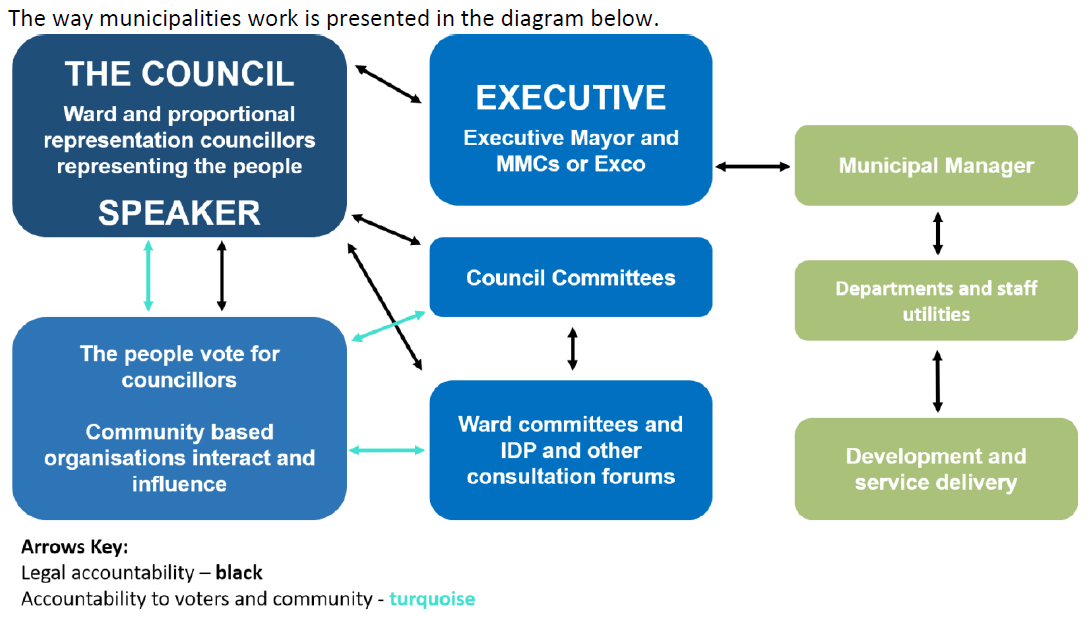
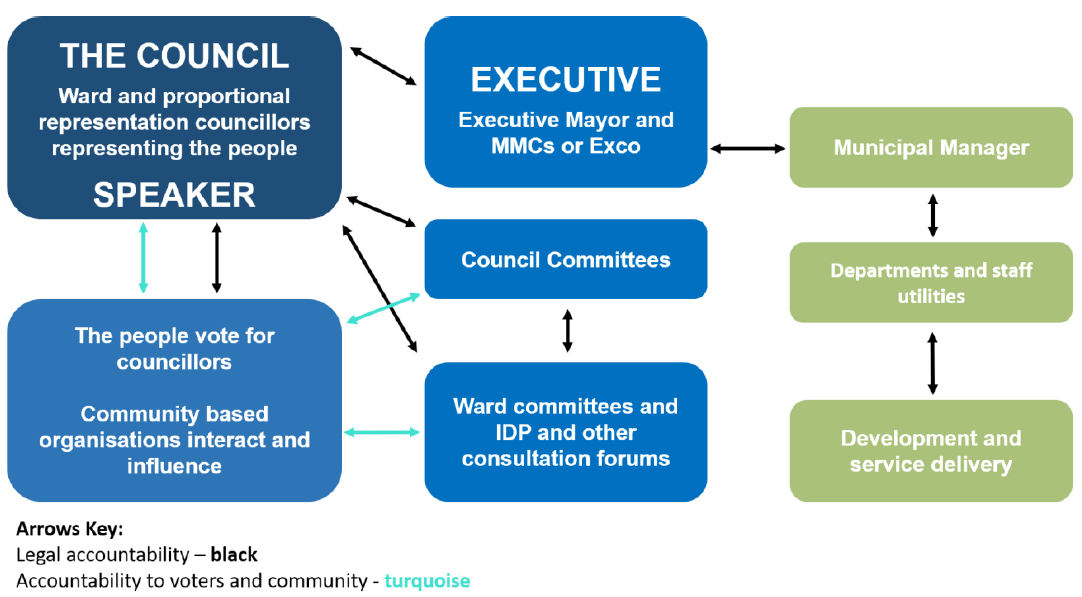
The whole of South Africa is divided into local municipalities. Each municipality has a council where decisions are made and municipal officials and staff who implement the work of the municipality.
The Council is made up of elected members who approve policies and bylaws for their area. The Council has to pass a budget for its municipality each year. They must also decide on development plans and service delivery for their municipal area. The work of the municipality is done by the municipal administration that is headed by the municipal manager and other officials. S/he is responsible for employing staff and coordinating them to implement all programmes approved by council.
The work of the Council is coordinated by a mayor who is elected by the Council. The mayor is assisted by councilors in an executive committee (elected by council) or a mayoral committee (appointed by the mayor). The mayor together with the executive or mayoral committee also oversees the work of the municipal manager and department heads. In some very small municipalities, the whole Council forms the executive — this is called a plenary executive.
The link between the community and the municipal mayor is the ward committee. These committees are also advisory committees, which can recommend actions to the mayor on any issues brought up by the community or affecting a ward. The ward committee is made of a ward councilor elected and acting as the committee’s chairperson, and up to 10 members from the ward elected by their respective communities. The ward committees in order to participate in a meaningful manner are supported and trained by the municipal council.
Proportional representation of councillors is a core principle in ward committees. It is important that ward committees be representative of local demographics. In rural areas, settlements are scattered, which should prompt having a higher proportion of geographically-based representatives.
Categories of municipalities
Metropolitan municipalities
These are known as Category A municipalities. Metropolitan municipalities, also known as Unicities, have exclusive municipal executive and legislative authority in their areas. There are eight of these:
Buffalo City, City of Cape Town, City of Johannesburg, City of Tshwane, Ekurhuleni, eThekwini, Mangaung, Nelson Mandela Bay29. Metropolitans have high numbers of people with a great deal of movement of people, goods and services, intensive development and multiple business districts and industrial areas. They also have complex and diverse economies require integrated development planning and are strongly interdependent in terms of social and economic relationships between the different areas.
Metropolitan municipalities ensure service delivery to the whole area. Metropolitans are divided into wards. Half of the councillors who serve in municipalities are elected through proportional representation with based on party votes and the through their election as ward councillors.
Local municipalities
Municipalities that are not Metropolitan are either district or local municipalities. Local municipalities are termed category B municipalities. This is the most common type of municipality.
District municipalities
District municipalities are category C municipalities. District and local councils are interdependent and involve a division of powers. A district council has municipal executive and legislative authority over a large area, its primary responsibility being district-wide planning and capacity-building. Within a district council's area are individual local councils which share their municipal authority with the district council under which they fall. District municipalities coordinate developments and service delivery for the entire district. Those who live in low population areas do not fall under local municipalities but only under district municipalities.
Functions of municipalities
But what do municipalities do? Municipalities are responsible delivery the following services:
- Electricity delivery
- Water for household use
- Sewage and sanitation
- Storm water systems
- Refuse removal
- Fire-fighting services
- Municipal health services
- Decisions around land use
- Municipal roads
- Municipal public transport
- Street trading
- Abattoirs and fresh food markets
- Parks and recreational areas
- Libraries and other facilities
- Local tourism
- Traffic law enforcement (some big municipalities also have their own law enforcement forces, such as the Metro Police in Johannesburg).
Municipalities get their income from money transferred from other spheres of government, as well as property rates, charges to users for municipal services rendered and other local taxes.
Chapter 7 of the Constitution establishes the role of local government, it includes:
- Status of municipalities – must be established for the whole country and proides guidelines for how municipalities should be run
- Objects of local government – including the relationship with communities
- Developmental duties of municipalities
- Municipalities in co-operative government – how municipalities must work with other government bodies
- Establishment of municipalities
- Powers and functions of municipalities
- Composition and election of Municipal Councils
- Membership of Municipal Councils
- Terms of Municipal Councils – limited to no more than five years
- Internal procedures
- Privilege
- Publication of municipal by-laws
- Organized local government
- Other matters30
There are various Acts that provide the national legal framework for local government.
The different types of municipalities are provided for in the Municipal Structures Act (117 of 1998). The Act is:
To provide for the establishment of municipalities in accordance with the requirements relating to categories and types of municipality;
to establish criteria for determining the category of municipality to be established in an area;
to define the types of municipality that may be established within each category;
to provide for an appropriate division of functions and powers between categories of municipality;
to regulate the internal systems, structures and office-bearers of municipalities;
to provide for appropriate electoral systems; and to provide for matters in connection therewith.
For each category of municipality (metropolitan, district and local), there are different types of municipalities laid out in the Act.
The Municipal Systems Act (32 of 2000) is to provide:
“for the core principles, mechanisms and processes that are necessary to enable municipalities to move progressively towards the social and economic upliftment of local communities, and ensure universal access to essential services that are affordable to all” 31
It gives a legal basis for the constitutional imperatives of local government and also:
- Defines the legal nature of a municipality and other legal matters
- Provides for municipal powers and functions
- Provides for community participation;
- Establishes performance management and organisational structures
- Provides for service delivery, credit control and debt collection
The Act requires that municipalities use an integrated development plan (IDP), which covers 5 years and is to be available on each municipality’s website. Citizens are able to give input into the plan.
The financial practices of municipalities are laid out in the Municipal Finance Management Act (MFMA). It applies to all municipalities and municipal entities. The Act is written:
To secure sound and sustainable management of the financial affairs of municipalities and other institutions in the local sphere of government; to establish treasury norms and standards for the local sphere of government; and to provide for matters connected therewith32.
The MFMA provides detailed requirements for revenue, budgets, debt, financial reporting, another financial management issues. The Act requires the publication of budgets and that municipalities invite the local community to submit representations on the budget (Section 22).
The Municipal Property Rates Act sets out how municipalities can charge rates. Its role is:
To regulate the power of a municipality to impose rates on property; to exclude certain properties from rating in the national interest; to make provision for municipalities to implement a transparent and fair system of exemptions, reductions and rebates through their rating policies; to make provision for fair and equitable valuation methods of properties; to make provision for an objections and appeals process;-to amend the Local Government: Municipal Systems Act, 2000, so as to make further provision for the serving of documents by municipalities; to amend or repeal certain legislation; and to provide for matters connected therewith.
The Municipal Demarcation Act makes provision for the Municipal Demarcation Board and establishes procedures for the determination of municipal boundaries33.
The Local Government Municipal Electoral Act is:
To regulate municipal elections; to amend certain laws; and to provide for matters connected therewith34.
This includes the voters roll, preparations for the election, election observers, voting, counting of votes and related matters.
Municipal councils are able to pass bylaws. They do this by suggesting a law and then voting on it. Bylaws are enforceable just like all other laws in the country. They can be accompanied by penalties and must be in line with the Constitution. You can also defend the charge in court. Bylaws provide guidance for the affairs and services in a municipality and can involve areas such as waste management, outdoor advertising, graffiti, street trading, fire safety, animals, public parks and others35.
Citizen participation in local government
Just as we discussed in reference to national government, on local government levels the public also have a right to participate. Local government is closest to the people and most intimately involved with ensuring that their needs are met. Participation by the public should help municipalities deliver the services that people need and to avoid conflicts around service delivery.
- People feel they have been consulted to find appropriate solutions to meet real needs.
- People can better understand what the municipality is trying to achieve and budgetary limitations.
- Councilors are more accountable to the people and are expected to report back to their constituencies.
- It ensures that municipalities as partnerships with communities, civil society organizations and businesses.

Last modified: Wednesday, 17 May 2023, 9:08 AM