
Page
An overview of the publishing industry
Completion requirements
CHAPTER 1: AN OVERVIEW OF THE PUBLISHING INDUSTRY

The aim of this chapter is to build your understanding of the publishing industry, the different market sectors, and the publishing process.
1.1. The history of publishing
After studying this section, you must be able to:
- Discuss the history of publishing, from print to digital, with reference to significant milestones.
1.1.1. The history of publishing in print
In about 200AD, people in China started printing on fabric and paper using woodblocks. This was a great innovation. Before this, copies of books always had to be written out by hand. This made books very expensive and only a few people could afford to own them. With woodblock printing, a whole page of text or pictures could be cut into a woodblock and many copies of that page printed easily and quickly. This made books much cheaper and more people could buy them. But many woodblocks were still needed to print a whole book – one woodblock per page.
The next great innovation in printing came about 1,000 years ago with moveable type, also in China. Instead of creating an image of the text and pictures on a page, and printing the whole page as one, people realised that they could make individual characters or letters, put them together in a tray and print different texts using the same characters. This was called moveable type because you could move the characters or letters in the tray, and make different words (and therefore pages and books) from the same characters.
The next innovation in printing happened in Europe, when Johannes Gutenberg invented a printing press that used moveable type in about 1450. From this point, printing technology spread across the world.
But publishing is not printing! Modern publishing involves much more than just printing books, magazines or newspapers – in fact, many modern publishers do not own printing presses of their own any more. Instead, they pay other companies to do their printing for them.
One of the most important jobs a commissioning editor, usually working for a publishing company, does, is to decide what to publish. The commissioning editor may then commission a writer to write what the publishing company wishes to publish. Sometimes publishing companies do not commission writers, but instead rely on writers who send in their works to be considered for publication.
A publishing company is also usually responsible for editing and illustrating a writer's work, producing it in a suitable form, marketing it, selling it, warehousing it, and keeping good records of what money a work has brought in, and what share of that money the writer is entitled to. This has not changed very much in the last 500 years, although writers were more often paid royalties in the 20th and 21st centuries, rather than fees as they were before that (and sometimes still are).
Some writers choose to publish their works themselves – this is called self-publishing and can take place in print or in digital formats.
Digital publishing started in 1971 when Michael Hart, an American, started Project Gutenberg. The Project offered to the public an electronic collection of 30,000 out-of-copyright classic texts and 100,000 books and novels free of charge. Hart initially retyped manually the text until 1989 when book scanning was made possible.
In the 1980s, more publishing companies experimented with CD-ROM. This era saw reference books like the Oxford English Dictionary published on CD-ROM in 1989.
The next decade saw the emergence of e-books (book publications consisting of text and images created in digital format) – and e-book readers (which are devices supporting the reading of digital
books).
In the late 1990s, there were attempts to release the first e-book readers like the Rocket eBook and the Palm Pilot. But these were not very successful and didn’t affect the book market much.
It was only in 2006 that Sony, in the United States, launched the Sony Reader with its E-Ink screen to create a comfortable reading experience. The reader could display PDF, EPUB format, and JPEG but also play audio files such as AAC and MP3. A year later, Amazon released the Kindle e-reader with a large offering of published e-books – most of them at a relatively low price ($9.99). By doing this, Amazon created a much easier way for the public to purchase and read e-books. Within five years,
they had seized 20% of the US trade book market. In parallel, Amazon expanded to other territories, growing their book catalogue and their customers. Other players like Apple and Google also profited
from the rise of the e-book, but even today, Amazon remains the leader in the market, owning about two-thirds of the global e-book market.
Publishing companies have not stopped at just creating “e-versions” of print material. They have expanded the concept of a digital book by adding new features. Nowadays, publishing companies can generate multimedia content that is distributed electronically first – in other words, not publish the print book first but publish the electronic content first. Educational publishers, for example, now create courses for students that include videos, audio components, interactive activities, and assessments along with the traditional text.
After studying this section, you must be able to:
- Analyse the South African publishing industry with reference to salient challenges and opportunities within the contemporary context.
South Africa is one of the most unequal societies in the world with the difference between poor people and rich people represented by its high Gini coefficient score. The Gini coefficient is an international measure used to show the range in incomes earned by the citizens of a country. If a country, like SA, has a high score, it means that there is a very large difference between the highest and lowest salaries. The political history of the country has influenced the spread of knowledge, the quality of education, and literacy levels.
Some parts of the population have very low literacy levels. Many people do not prioritise reading as they face pressing socio-economic challenges, including unemployment. Nevertheless, they may value education highly, because they consider it to be a a way of accessing a better life, especially for their children. Even then, their children usually only access books and learning materials in public schools. The suitability of the books is determined by the efficiency of processes run by government
and its appointed agents to select, purchase and retain learning materials for school-goers to use.
In South Africa, there are also highly educated people with disposable income – some of this group prioritise buying literature, or accessing knowledge by reading journals, research, other academic material, and textbooks.
And in between there are many South Africans whose age and lifestyle segment influences their creation and consumption of content, literature, books and other published materials. They also participate to varying degrees in book clubs, visit book shops, attend book fairs, and use libraries.
They have differing attitudes towards pirated materials and materials shared in social media groups.
South Africans share a rich cultural heritage and diverse histories. We speak, read and write 11 official languages. We are part of the African continent as well as having access to knowledge and research from other parts of the world.
This is the South African environment in which publishers operate. The challenges in the context mean there are complex and interesting challenges for publishers. These challenges include harnessing the creativity of writers in a way that creates a revenue stream (and thus employment and reward for authors), improving literacy levels by creating materials that help young learners (and adults), and running viable businesses that create employment for South Africans involved not just
in the creative side of publishing but administration, finance, logistics and distribution, while competing with international publishers and knowledge-providers for a share of customers’ disposable income.
There are many different kinds of publishers, or publishing enterprises, in South Africa. They can be categorized as follows:
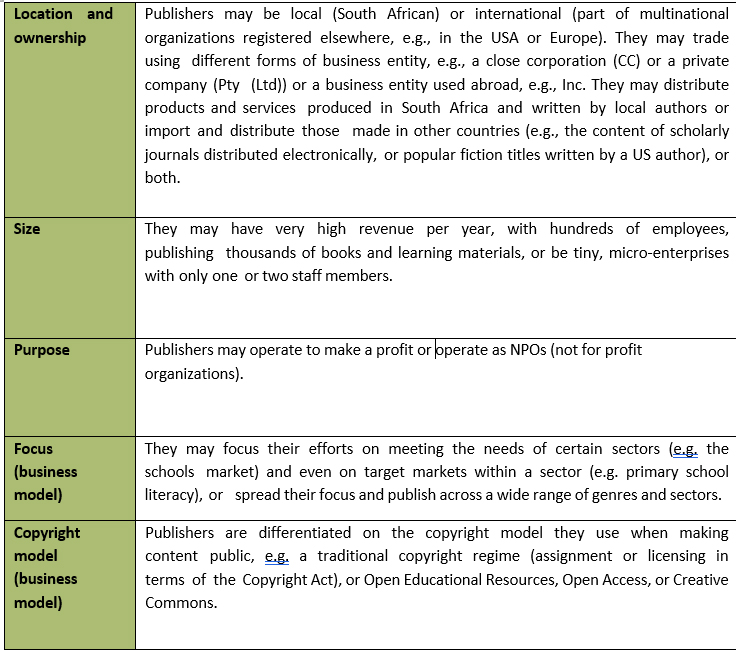
Table 1.1. Differentiating features of publishing companies
Lastly, as mentioned briefly before, there are authors who choose to self-publish (funding and distributing their own content or product) rather than work with publishing companies. The rise of self-publishing has been influenced by the availability of a self-publishing model hosted by Amazon, the US electronic bookseller.
Publishers operate in South Africa in a context shaped by a particular policy framework. There are Government agencies that support the development of publishing. They include:

Table 1.2. Government agencies that support the development of publishing
There are also a number of professional associations that enable member publishers to connect and make sense of common issues facing the publishing industry, offer training and development, and engage as groups with policy-makers. They include:

Table 1.3. Professional associations of publishers
Other organizations that it is important to know about include:
- DALRO, the Dramatic, Artistic and Literary Rights Organisation, a multi-purpose copyright collective management agency and rights broker which administers aspects of copyright, including income, for artists, authors and publishers
- ANFASA, the Academic and Non-Fiction Authors Association of South Africa
- Universities that offer training for publishers, such as the University of Pretoria and Wits University, and in intellectual property, such as the University of Stellenbosch and the University of Johannesburg.
- SABA, the South African Booksellers Association
At the most basic level, literacy is the ability to read and write, and to understand what you read and write. Modern education in South Africa depends on children being literate, in two or more languages (a person wanting to get a National Senior Certificate, or matric, must study one language at Home Language level, and another language at First Additional Language level, and pass both subjects).
Again, at a basic level, if children cannot read and understand their textbooks, or listen to and understand their teachers, they will not be able to be successful in any of their subjects at school.
Most of the children in South Africa study from grade 4 onwards (at least) in English – for most children, this is not their home language or the language that they are most competent in. This environment makes literacy in English a very important skill.
According to the TIMMS & PIRLS International Study Centre at Boston College in the USA (2018), in an international study of reading performance conducted in 2016, 78% of South African learners in grade 4 are unable to read for meaning in any language (whether their home language or an additional language). Reading for meaning means that you understand what you have read and can show that you understand, e.g. by answering questions about a text you have read. Not being able to read for meaning by grade 4 makes learning extremely difficult, and makes it much harder for children to meet the requirements of tertiary education. Without a tertiary education, people usually earn less and find it more difficult to get a job.
Problems with literacy can therefore impact on people's whole lives, not only on their experience at school. Improving literacy is therefore a key challenge for South Africa.
In addition to the ability to read, write and understand, there are other kinds of literacies, for example, academic literacy, number literacy, computer literacy, visual literacy. In this context, literacy means competence in, or knowledge of, a particular area. These literacies, or skills, are also very important, contributing to people's ability to find work and lead a comfortable life.
In the past, people relied on listening to stories about their community, in person, or on the radio. They read printed books or printed newspapers to gain knowledge or news, or be entertained.
Today, many forms of entertainment compete with books for our attention and our disposable income. They create expectations about what books should be and do. This is particularly true among young people, who may find traditional printed books "boring", long or difficult to get hold of. They may not pay enough attention to books because they are used to more "exciting" and responsive forms of entertainment, or content like movies, TV series, social media and games.
Think about this. You can stream a YouTube clip and watch it easily on your cell phone. Your family may subscribe to pay-TV channels or have a fibre network or WiFi in the neighbourhood, so you are able to stream series and movies from Netflix. It is fun to go to the mall with friends to watch a movie at Ster Kinekor or NuMetro.
You get information by using cellphone data to access news and other websites from your phone, or use a laptop (or desktop) and Internet access at your college or library to view your study materials and do assignments and projects.
The websites and social media you use, like Instagram, Facebook and Twitter, make you used to consuming information fast and in small bits. They are in colour, have interesting layouts, and respond quickly. You can share information via WhatsApp groups.
All these aspects of the current environment mean that a book publisher is competing with a wide range of other media, and therefore needs to ensure that a book uses words, layout and features that attract the reader in the target market, and make the book easy to use. These factors also shape how the book is marketed to the reader, sold and distributed.
There are number of reasons why it is important that books and other materials are published, and should continue to be published, in the indigenous languages of South Africa. (An indigenous language is one that is native to a country or area, and is spoken by the indigenous people.) These include:
- educational requirements: textbooks, readers, literature and reference books, such as dictionaries, must be available for students of a language, whether at Home Language level or as an additional language;
- giving the community and its writers a voice, e.g. to explore or represent their current experience or opinions, their heritage or their history;
- giving other communities the opportunity to learn about the cultures associated with the language (not for education, but informally) and the opinions of the speakers of a language;
- giving speakers of the language an opportunity to see their stories and their experiences represented in literature or other books and realise that they are valuable;
- enriching the language by using it in different contexts or domains, e.g. science, medicine, poetry.
Some people feel that because they are speakers of an indigenous language, they do not need to study it, or have any books in it. Others feel passionately that it is their duty to use their home language as much as possible, to ensure that the language stays alive and stays relevant to modern life.
Studying a language, even if it is your own, deepens your understanding of how languages work in general, and allows you to become a subtle and persuasive user of a language. Using language well and carefully is a skill that is necessary or useful for many types of work, and for life in general.
Making content available in many languages presents certain challenges and opportunities to publishing companies, mainly because the languages vary greatly in terms of numbers of speakers. (You can find out more about this by reviewing the latest South African census figures, e.g. for the 2011 Census on Wikipedia see https://en.wikipedia.org/wiki/Languages_of_South_Africa.)
For example, more than 22% of South Africans speak isiZulu, while 2.1% speak isiNdebele. For a publishing company, these differences are a challenge because it would usually cost as much to produce a book for isiNdebele as it does for isiZulu, although the income from the former is likely to be much smaller than that from the latter. The result is that products for languages with smaller numbers of speakers are usually less profitable than products for languages with larger numbers of speakers.
The number of languages also presents a challenge in terms of sheer numbers of titles: if an educational publishing company makes a numeracy series consisting of a textbook, a workbook and a teacher's guide for each grade in Grades 1 to 3, and it wants to offer the content in eleven official languages, it will need to make 99 titles. (The calculation is three titles per grade for three grades for each of eleven languages.) The sheer volume of titles will occupy a large number of people in the support teams (e.g. administration, production, warehousing, finance) as well as in publishing, making it difficult for the business to continue publishing in other areas. Continuing to publish in other areas (i.e. having a diversified product offering) is important for most publishing companies, because it diminishes the risk to the business of a particular publishing list failing.
Publishing in many languages also presents opportunities: the number of languages offers companies an easy way to diversify, and encourages organic growth through translation, adaptation and versioning. It also stimulates innovation as publishers look for ways to work more efficiently and re- use content wherever possible, including artwork and design. It brings the company into contact with a wider range of customers and suppliers. All these things can strengthen a business, making it more resilient to unexpected events, and more closely reflective of its diverse target markets.
In South Africa, a wide range of books or products is available, including books or products that are: published by local publishers;
self-published by local writers; published by international publishers; self-published by international writers.
These books or products may be in print or digital form. What are the differences between books or products published locally (by a publisher or a writer) and those published internationally?


Table 1.4. Differences between local and imported products
Ideally, people should be able to choose the book or product that most suits their needs, regardless of whether it is locally or internationally published, but this is not always possible in practice.
After studying this section, you must be able to:
- Assess and contrast the different market sectors in the publishing industry in terms of characteristics, challenges, opportunities, and viability
Let’s start by defining the concepts market and market sector. By market, we mean the group of customers for a particular product or service. By market sector, we mean a group of similar businesses that forms part of the economy. The overall market sector that South African book publishers serve is customers who buy books and related services. This big group of customers can be divided into smaller groups, or sectors. There are five major sectors in the publishing industry in SA, each with its own characteristics.


Table 1.5. Characteristics of the different market sectors in South African book publishing **
** This table is based on information drawn from the University of Pretoria’s The Annual Book Publishing Industry Survey 2016.
The University of Pretoria researchers say that not all publishers in South Africa responded to their 2016 survey. This means that their conclusion about the size of the local publishing market is an estimate based on information given by the publishing companies that did respond.
The estimated total size of the local market in Rand value in the 2016 financial year was R3,296,262,000, or, in other words, R3.2 billion. This means that book publishers reported they sold R3.2bn worth of local printed books, local digital books, and local book-related products in the period. This is a net value, excluding tax paid to government and delivery fees allowed to booksellers. Other parties who calculate the size of the South African publishing industry as a whole think that the PASA results represent about 55% of the market size.
By market share, we mean the percentage that each of the market segments has of the total revenue generated by publishers from local products. In tabular form, market share is:
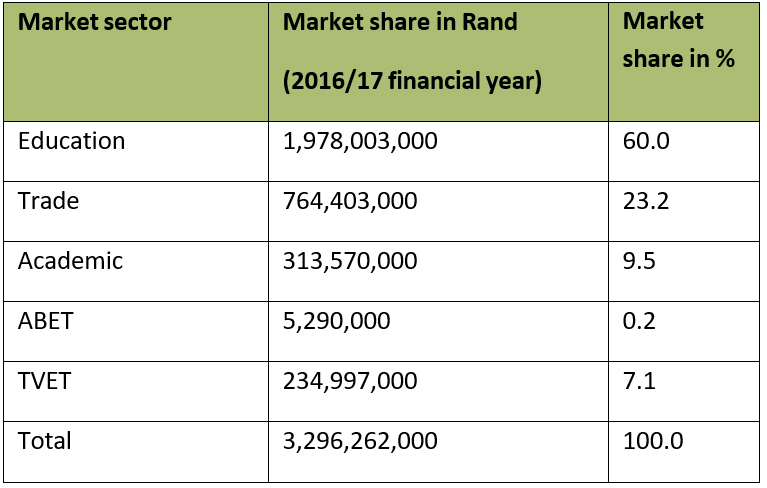
Table 1.6. Market share by sector: South African publishers’ local product
Each of the sectors also has a set of sub-characteristics, or dynamics, meaning trends, events or policies that influence how publishers in the sector perform.
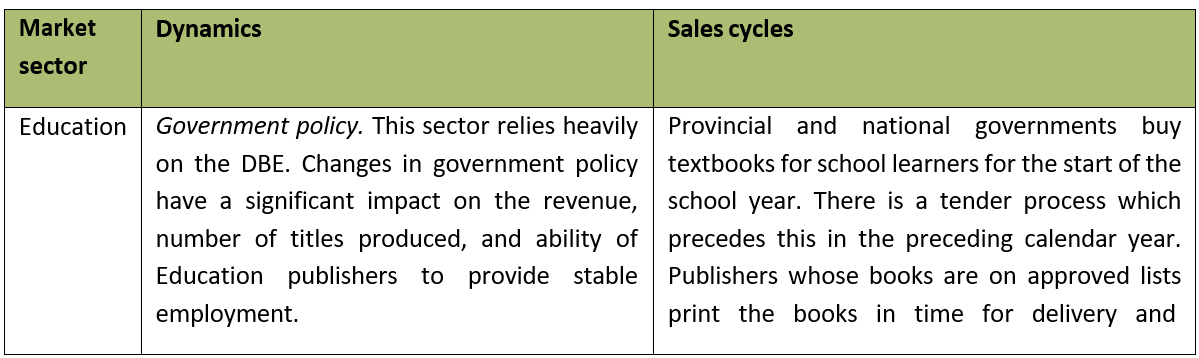


Table 1.7. The dynamics and sales cycles of publishing market sectors in South Africa
All of the market sectors contribute more than the Rand value of the revenue they generate to the economy.
Royalties and author fees. Publishers give creative and/or knowledgeable people the opportunity to generate an income from the rights related to their intellectual property. Authors may earn a percentage of the net receipts from the sale of their books in compensation for the intellectual effort they put into developing and providing the content. Alternatively, authors may earn fees for their content. Publishers therefore ensure a revenue stream for authors, by investing in their books, distributing and marketing them, and ensuring that monies owed to the authors reach them.
Employment. A PricewaterhouseCoopers (2017) report states that publishing companies employed 7,657 people, full-time or part-time, in 2015. This does not include authors.
Education, knowledge and development. All publishers, by making carefully curated content available in textbooks, monographs, journals, works of literature, teacher guides, exam preparation guides for professionals, reading and numeracy schemes, etc. enable the end-users to access learning and knowledge, become educated, learn technical skills and vocations, enjoy entertainment, explore hobbies, and, effectively, improve their lives.
The political environment most obviously affects the Education sector. Since 1994, successive education ministers have wanted to address the impact of apartheid education, and incorporate modern thinking on education and best teaching practice into revised curricula.
The curriculum for public schools has been revised numerous times since 1994. Each time the Department of Basic Education revises the curriculum, publishers submit new learning and teaching materials (textbooks, teacher guides, resources) for possible inclusion in the provincial or national catalogues from which teachers select books to use. Publishers and authors whose education products are in the approved catalogues, generate considerably higher revenue than those whose products are not. In 1997, many publishing companies retrenched staff as there were no opportunities to make new books for the school curriculum. The 2000s were boom years for educational publishers but since the mid-2010s, there has been a significant decline in submission opportunities and government procurement practices. As a result, there have again been retrenchments at several big educational publishers.
Another example of politics affecting publishers occurred when the Higher Education part of the Academic sector was disrupted by the #FeesMustFall movement at universities in 2015 to 2017. Protests were against issues of fee increases which excluded poor students. The "missing middle" students felt unsupported by the National Student Financial Aid Scheme. The protests grew to include issues of access to higher education generally, including the employment of black academics. Protesters supported the transformation of universities from what they saw as elite institutions with mainly Western curricula to institutions reflecting African students and diverse curricula. The protests affected publishers, firstly because the supply of textbooks, through booksellers to students, was disrupted, as were classes and exams at many institutions. Secondly, publishers realised that they needed to evaluate whether their textbooks for South African students do in fact support the students properly, e.g. through their features and by including knowledge to them. This has led to the revision of some textbooks.
A trend mentioned in the characteristics and dynamics of the market sectors is “digital”. People outside the book publishing industry often assume that e-books have devastated the book trade. It is true that digital publications have come to the fore in some sectors internationally. For example:
- International journal publishers sell access to electronic journals using a subscription model
- The sale of adult fiction titles published as e-books, bought via the electronic bookseller Amazon (or similar, such as Kobo) and read on devices such as tablets or e-readers, has increased.
In South Africa, there are policy developments that suggest the government intends to promote digital publishing for education. Publishers are adapting their content generation and production processes, their contracts, and their suppliers, in order to disseminate learning and teaching materials digitally.
A second trend is that attitudes towards copyright material are changing. Many end-users do not completely understand the concept of authored material being owned by the persons who created it or published it, or the need to ask and acknowledge those persons or publishers when re-using the material. End-users use pirated copies of the original materials instead of buying the books. There is a perception that the right to education, for example, trumps the rights of authors and publishers to earn an income from the content they have produced.
The Copyright Act of 1978 is being amended by government. A Copyright Amendment Bill was passed by the National Assembly of Parliament in December 2018 and introduced to the National Council of Provinces for approval. If passed and signed by the President, this could decimate educational publishing in South Africa because it applies a "fair use" principle to educational content. In other words, the amended legislation will mean that people using an author’s content for an educational purpose will not have to pay for permission to reproduce and use it.
Because such a large proportion of publishing in South Africa is educational (i.e. the Education sector and most of the Academic sector) and the proposed amendment will negatively affect publishers and authors in these sectors, the publishing industry as a whole may be negatively affected. Some of the revenue from the sale of educational products enables publishing companies to invest in other kinds of products, which may not generate as much revenue, or do so as reliably. However, some argue that non-educational publishers and other industries will benefit from the amended legislation since people and institutions who would have had to pay for access to content will now be able to spend that money in other parts of the economy.
After studying this section, you must be able to:
- Describe the elements of the print and digital publishing and book manufacturing process using the correct terminology
- Analyse the effect of technological development and innovation on the publishing and book manufacturing process in terms of present and future challenges and opportunities
There are many elements to the publishing and book manufacturing process. The majority of the key terms related to this process are explained thoroughly in Chapter 9, as well as in the glossary. However, you will need to understand the following key terms to gain the most out of this textbook:
- Manuscript: This is sometimes referred to as the raw manuscript; it is sent to the publishing company by the author; it is raw in that it has not been developed, checked, edited or typeset and may still change in many ways.
- Authors: These are writers who either write the manuscript by themselves or contribute to a project as part of a team of writers; they provide content which is their intellectual property – they may later assign the rights to this intellectual property to the publishing company, or they may retain some or all of the rights.
- Editing: Once the manuscript has been approved for production, it goes through a number of editing processes; these can be developing the manuscript, content editing the manuscript and/or copy-editing the manuscript; editing is the task of improving the manuscript at different levels to make sure it’s accessible to the reader.
- Design: There are a number of design elements in book production, especially designing the cover and designing the spec for the inside pages; this design will give the book its unique look and feel.
- Typesetting: This is the process of converting the raw manuscript text into content which can be printed or made available digitally; this is usually done with particular software which can accommodate the design styles as well as illustrations.
- Artwork: This can refer to technical drawings, illustrations, photos, figures or tables which complement the text; they are used differently depending on the kind of book and often make the text more accessible and understandable for the reader.
- Page proofs: These are usually pdfs which the typesetter provides to the editor or project manager; there are usually three sets of pages proofs which need to be checked, proofread, used for artwork commissioning and indexed; the final set of page proofs is called the master set; typesetters will then supply a print-ready pdf.
- Printing: This is the process of producing multiple copies by a printer; it includes various technical checks, checking layout, and providing proofs for checking.
- Publication: This is when print books are brought into stock at the warehouse and are available to dispatch to bookshops and other retailers.
- E-book: An electronic book that can be read on computer, tablet or cellphone. PDF and EPUB: E-book formats that will be described further in Chapter 9.
- Metadata: The descriptive data that accompanies the e-book, e.g. its title, ISBN, and author.
- Digital conversion: The process of creating an e-book from a book (or master set of typeset pages).
- Interactive assets: Items that complement the book content, such as a video or an animation, or interactive items that together form the whole product.
We will discuss terminology in more detail in Chapter 9.
An ISBN is to a book what an identity number is to a person. ISBN stands for International Standard Book Number.
An ISBN is a unique number allocated to one publication or edition of a publication, made by a specific publisher, in one format. The number is unique in that it can only be allocated to a single publication
– each format of the same publication (whether a print book, an e-book, an audio book or a mixed media book) would receive its own ISBN. The ISBN is printed on the back cover of a physical book and included on the copyright page of print and digital products.
An ISBN has 13 digits which are divided into 5 distinct segments, each separated by a space or hyphen. A person who can "read" an ISBN is able to detect information about the publication, as in this image sourced from the International ISBN Agency, 2014:

- The prefix segment – is either 978 or 979. It always contains three digits.
- The registration group segment – is the next one to five digits. It represents the country of origin, or the geographical region, or language area.
- The registrant element – identifies the publishing company or the imprint they are using. It can be up to seven digits long.
- The publication element – identifies the edition and format of the title, and can be up to six digits long
- A check digit – this is the last, single digit. It validates the rest of the number.
The ISBN system is run on an international, national and publisher level, from the ISBN International Agency (IA), the global authority for the ISBN system situated in the United Kingdom. The accuracy of the ISBN system rests in that, all across the world, more than 160 agencies tasked with administering ISBNs are governed by an international standard, the ISO 2108: Information and Documentation. In South Africa, the International Standard Number (ISN) Agency is based at the National Library of South Africa (NLSA). The NLSA ensures that batches of ISBNs are issued to publishers for use on their books. Once an ISBN is allocated to a book, a record of what book it is attached to must be sent back to the NLSA.
The importance of ISBNs is that:
- They are used for information-processing by all parties in the publishing value chain – including publishers, booksellers, other retailers, distributors, and libraries. ISBNs are used for ordering and listing books in catalogues, and for stock control.
- They identify any South African publication worldwide and facilitate its listing in directories including those on the Internet. This means users can search for information on where to obtain the publication.
- They record accurate information on South African publishers – who published what.
- They give a “label” to the copyright content that an author has assigned to or licenced to a publisher in their contractual agreement, in addition to the title of the book. If an author has signed a contract with a South African publisher assigning copyright to that publisher, and the author's book is identified by an ISBN, it means that that unique book with the same content cannot be published by another publisher for the term of the contract.
- They help keep records of all books published up-to-date – as required by the Legal Deposit Act of 1997. Individuals who publish, or publishing companies, are required by law to submit copies of their publications to a repository. The purpose is to preserve South Africa’s written, and published, heritage. In South Africa, the repository for printed and digital books is the NLSA.

Diagram 1.1. The publishing value chain
Commissioning editors often get comments like this, “Oh, you’re in publishing. So, you edit books -- you must spell really well?” The reality is that an individual commissioning editor is someone who makes something tangible out of something intangible (intellectual property). She is capable of translating the needs of the target market into a print or e-book that satisfies those needs. She is the person at the center of a process of taking content generated by an author through a “manufacturing” process, directing the activities of others, to achieve this. She possesses business acumen and can guide her employing company to make investments in a product, or not. The publishing value chain is thus about the value that a commissioning editor, or publishing company, adds – between the time that an author creates a manuscript of their own volition (or is briefed to write all or parts of a manuscript), to the point after which that manuscript (converted into a product) has been sold.
Diagram 1.1 explains the steps in the chain. First, content is created. For example, a talented person writes a work of literature that general readers may enjoy. Or a group of teachers are commissioned by a publisher to write chapters of a textbook for a certain subject according to a certain curriculum.
Second, or in a parallel process, the publishing company decides to invest its resources in a series of activities to support the authors, generate reviews of the content, edit it, create the design for the product, create or get permission to use artwork, get permission t use third-party content, typeset the work, index it, choose paper and binding for the book, and fund a print run, or create digital files of the typeset work for electronic distribution. At the same time, the publishing company is incurring expenses such as office rental, staff costs including those of marketing and sales, warehousing, IT, distribution, and after-sales service to customers, and needs to deliver a profit to its shareholders.
From the description of the publishing value chain, you can see that there are role players throughout the publishing process. Roles include:
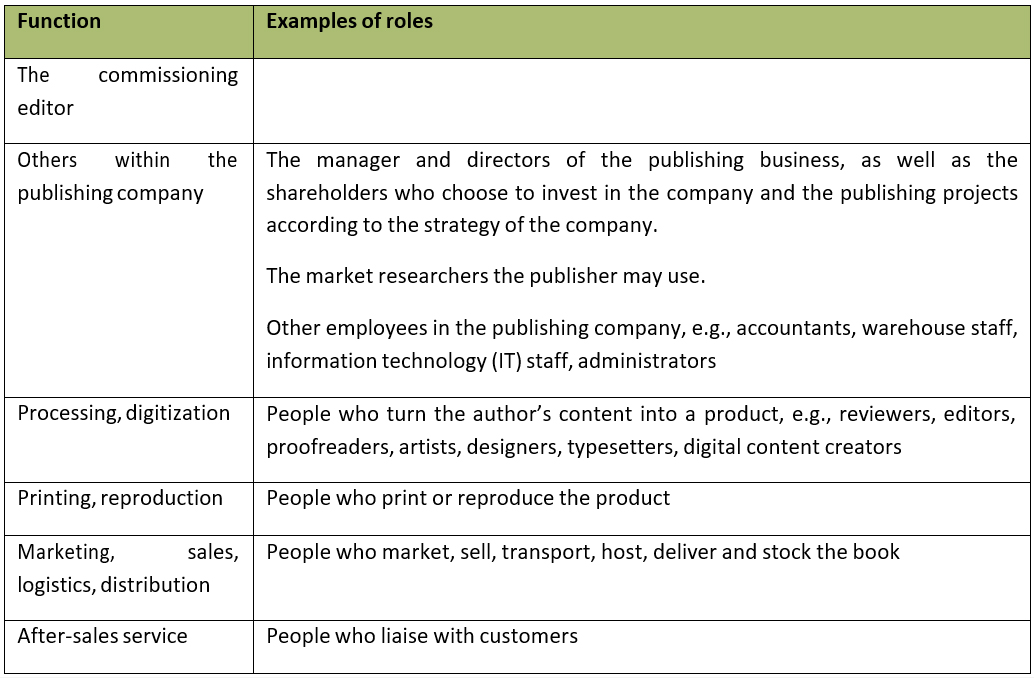
Table 1.8. Roleplayers in the publishing process
The production process diagram is available as a resource at the end of this chapter, and the print and digital processes are described in detail in Chapter 9.
When considering the production of your book, you need to think about what kind of product you are producing, what you want the product to look like, and how you want it to work (especially for digital products). These are important considerations as they will both affect the suitability of your product for its target market, and the cost of making it.
- Will this be a paperback (a book with a thin cardboard cover) or a hardback (a book with a thick protective cover)?
- What format or size will the book be?
- What will the extent be (the number of pages)?
- What kind of paper will the book be printed on?
- What kind of binding (stitching or glue) will hold the book together?
- Will the design for the product use colour, and if so, how will colour be used?
These decisions will impact the production and printing costs of the book, as well as the authoring process, costings, pricing and position in the market.
If you create an e-book in addition to (or instead of) a print book, you will need to make the book in parallel to the print book, in a digital format like EPUB, trying to conceptualize the e-book ahead of completing the print book so it’s not an afterthought.
Below are some examples of when a parallel process for a print book and an e-book will be best.
- When obtaining permissions (e.g. image, text permissions), you may need to get print and digital rights.
- You may need to get a print and a digital ISBN, and list both in your marketing material and on both imprint pages.
- Preparing a digital PDF could impact on the typesetter’s time and carry a cost if it’s done after the print PDF.
- Creating interactive assets will take a substantial amount of time, and may also impact on your book copy or layout.
- You may want to get artwork created in colour, even if your print title will be in black and white, because colour does not cost more in digital. Consider the costs, however, as colour artwork usually costs more than black and white.
Every e-book format has its own set of technical specifications. Make sure that you understand these specifications so you can plan the digital conversion or production in the best way.
Book design is an overall term that includes a number of elements related to a book, namely the styling, formatting, illustrations and fonts (typefaces) used in books. You will read more about these later in the Learner Book.
Typography is an especially important part of designing a book. “Typography” means how the text flows and is arranged on the page. Clear, well-arranged pages with a clear and uncluttered font help the readers to engage with the text. Good typography makes reading easy. It ensures that important text is highlighted – for example, when it is set in a bold or italic font.
You will come across the following concepts when you learn about typography:
- Font size (usually expressed as a point size e.g. 10-point font) and type (the names of different typefaces eg. Helvetica, or Times New Roman)
- Leading (the spaces in between letters)
- Type hierarchy for various heading levels, body text, diagram labels. This refers to the use of different fonts and effects for different headings. For a chapter heading you might use bold letters, capitalised. For a section heading, you might use italic letters, with big and small letters (upper and lower case).
- White space to allow "breathing" space for the eye to "rest" on the page or layout
- Line length and margins
- Serif fonts have tails on the end of the letter strokes that help to lead a reader's eye to the next word, e.g. Times New Roman font. Serif fonts are more suited to reading large chunks of body text, especially if the book is typeset in a small font size.
- Sans serif fonts are "clean" fonts with no tails, e.g. Helvetica font.
In the Education sector, in Foundation Phase books (for Grades R to 3), reading book line lengths are short, with fewer words on each line, and usually in a larger sans serif font between 18 and 30 points in size. A special font may be needed to match the letter shapes children are being taught to write.
Books for the Academic sector use a smaller font averaging between 9.5-12pt in either a sans serif ora serif font.
Books for the Trade sector vary significantly in the font size they use. A children's picture book will use a font and font size similar to that mentioned above for a Foundation Phase reading book, while a religious book for adults might use a large or a small font, either sans serif or serif, depending on its purpose. Dictionaries and other reference works commonly use smaller fonts with a clear font hierarchy because the reader is not expected to read large chunks of text, but needs to find the information they need quickly.
For works in African languages at any level, you will need to check that the font you use accommodates diacritics. These are extra typographical characters which are used on particular letters in some of the African languages e.g. Sesotho sa Leboa, and Tshivenda.
When you work in publishing, you will hear people talk about “colour models” and use other terms to describe colour. While you would think you can describe colours as the seven colours of a rainbow, that’s not what we mean here!
Here are some of the most common terms you need to learn:
- B/W: This stands for black and white, or black text or black line drawings on white paper. When a book is printed in black and white only, it is called a one-color book. If illustrations are in black and white only, they are one-color illustrations.
- Greyscale: This means shades of grey from black to white. Between dark black and white, if you lighten the colour black, you get shades of grey. Publishing companies sometimes use these shades of grey colour to create variety in the appearance of black and white books, or in black and white photographs.
- RGB: The abbreviation stands for Red, Green and Blue. RGB is a colour model. It refers to the way that red, green and blue light, when combined in different ways, creates many other colours. Computer screens and TV sets uses the RGB colour model. So, you will find the concept of RGB used when talking about digitally-published products.
- CMYK: The abbreviation stands for cyan (blue), magenta (red), yellow, and black. CMYK is a colour model, used in colour printing, and it is a term also applied to the printing process itself. The "K" in CMYK stands for "Key". It's also the last letter of the word "Black". The letter K has been usedfor black as the B has already been used for blue or cyan. The term CMYK is used to describe afull-colour book.
Let’s recap. In publishing, even when working as a commissioning editor who does not need to know everything about printing or design, you need at least a basic understanding of the colour model concept. As you will see in Chapters 2 and 4 in particular, when a commissioning editor proposes that her company publishes new product, she will make recommendations about the nature of that product – including, whether a book should be printed in black and white, or colour, to meet the requirements of the target market. If she proposes a digital product, she will need a basic understanding of the preparation of digital files particularly if she is involved in conceptualising, briefing, or monitoring any part of the digital production process. Read more about that in Chapter 9.
As was discussed earlier in this chapter (see 1.1.1), Johannes Gutenberg invented the moveable-type printing press in about 1450. One of the first books printed was the Gutenberg Bible. Since then, print technology has evolved to produce faster and cheaper books, for both long runs and quick turnaround (e.g. print on demand, or POD). In 2007, Amazon launched Kindle, the first digital e-book reader.
There are four main stages in modern printing:
- Plate making: After the printer checks the typesetter's print-ready files for technical errors and the publishing company has signed off a proof, the printer makes plates for the book by exposing the image for the entire book onto thin metal sheets.
- Printing: The printer then puts the plates on the printing press. If the book is in one colour (i.e. black and white), the paper will go through the machine once. If it’s a full colour book (using CMYK process colours), the paper is still fed through the machine once, but this time the machine is a four-cylinder colour machine. Each cylinder represents one of the process colours.
- Binding: After the sheets of paper are printed and dried, they go to the to the bindery. The pages are folded and collated into 16-, 32- or 64-page sections which are sewn or glued together. The binder glues the spine on, attaches the cover, and trims the book to size. If the spine is thicker than 21 mm, it’s better to threadsew the book blocks before gluing them and attaching the cover. A book block is the finished “block” of glued or sewn pages, the inside of the book, before the cover is attached to the outside of the book. Threadsewing makes the product extra strong and durable.
- Finishes: A cover finish is an extra layer put onto the cardboard or other material that the cover is made out of. Sometimes this is done to make the cover durable (especially for Education and Academic books), and sometimes it is done to add visual impact (especially for Trade books). The most common cover finishes are machine varnish, matt varnish, silk varnish, gloss varnish and UV varnish. Machine varnish is the preferred finish for textbook covers as it is non-reflective and the cover is protected from scratch marks and ink rubbing off.
Because of the wide range of printing machines available, printers tend to specialise in what they can offer and are able to produce. Some focus mainly on small-format printing, like books and magazines, while others are capable of printing large formats like A1 posters or newspapers.
Printing machinery and equipment can be very sophisticated and costly, and varies depending on the type of product being printed. The most common machinery is described below.If you can, try to arrange to visit a printing press with your team, or other colleagues, as it can be very informative to know how printers work.
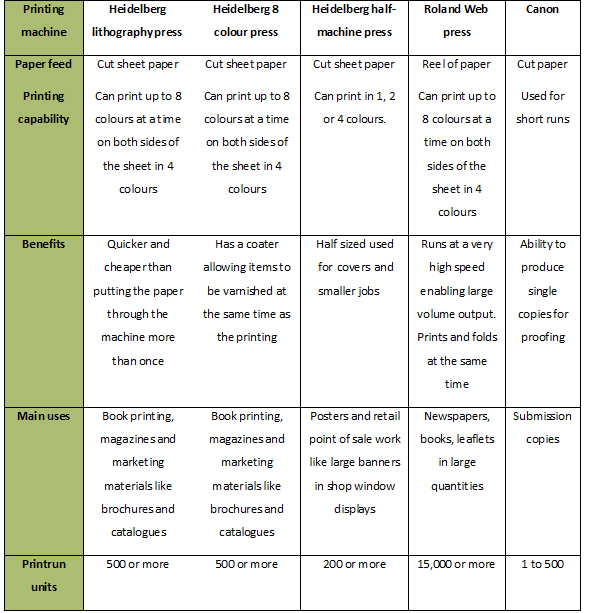
Table 1.9. Common printing machinery, its uses and capacity
After studying this section, you must be able to:
- Define career paths in the publishing industry
Publishing companies may employ staff in permanent positions for all or some of the functions described in the publishing process.
The decision whether to employ people permanently or on fixed-term contracts, or to use them on a freelance basis, depends on a variety of factors. These include:
- The company’s employment strategy (set by its owners or management). For example, an international company may not hire IT experts locally but may require staff in the South African part of the firm to use IT experts located in another part of the company elsewhere in the world such as in India.
- The requirements imposed on the publishing company by the labor laws in the country, and any other relevant aspects of the legal framework, such as laws around transformation.
- The state of the economy may influence whether posts included in the company’s organogram are filled or not.
Generally, a publishing company will offer people permanent employment in order to fill roles essential to fulfilling the strategy set by the directors and approved by the shareholders. These may
include the role of commissioning editor, or some particular commissioning editors, for example those with specialist skills or a particular reputation. For example, a person with the expertise to
publish math or statistics textbooks may be less easy to find compared to, say, a person to publish English language textbooks. Or, for example, an experienced publisher of professional books for lawyers may be able to persuade high-profile legal experts to publish with her company, whereas ales-experienced person may not.
Sometimes, a person may work his way through different roles within a publishing company. For example, he may initially be employed as an editor, and then show insight into the market segment, the ability to negotiate with and persuade authors, and progress into an assistant commissioning editor role.
Roles in publishing companies are not restricted to those directly related to publishing. The value chain shows that you can secure employment in various support roles, such as administration,
finance, logistics, and information technology.
The sales cycle and the characteristics and dynamics of the different market sectors result in opportunities for freelance employment in the South African publishing industry. There is a large circle of experienced people for certain functions in the value chain e.g. Afrikaans language editors. In some sectors, such as Education, there is a high demand for reputable service providers for other services, e.g. translators into the African languages. Across the sectors, competent and reliable project managers and proofreaders are necessary.
Contract employment may be offered using service level agreements or fixed-term contracts. Examples include:
- Freelance project managers and editors when an educational publisher is involved in preparing textbooks for submission and approval by Government Freelance sales consultants to promote a company’s books to booksellers or end-customers when there is seasonal demand
- Freelance artists to illustrate specialist books, e.g. a book on the snakes of South Africa or a medical text aimed at post-graduate students
Last modified: Wednesday, 17 May 2023, 9:04 PM