
Page
1. Learner orientation
Completion requirements

Chapter One: Learner orientation
In this chapter
- Certification, the national qualifications framework (NQF), the Quality Council for Trades and Occupations (QCTO) and the National Learner Record Database (NLRD).
- The Qualification structure
- Exit level outcomes
- Module alignment
- Credits
- Entry requirements
- Assessment
- Learner support
- Programme evaluation forms
Welcome
Welcome to the occupational qualification in journalism. These materials have been developed by and in consultation with top journalism and journalism training professionals to ensure that you have the fundamental skills required to be a journalist in the changing current conditions that mark the media industry. For this reason, the qualification not only provides practical journalistic skills, but is consolidated through workplace experience, and the other skills that are critical for successful professionals. We wish you all the best as you embark on this challenging and exciting career!
Certification and NLRD
This qualification is a nationally recognised qualification and is registered on the National Qualification Framework (NQF). Upon successful completion of this learning programme, you will receive a certificate authenticated and issued by the Quality Council for Trades and Occupations (QCTO). Your training provided will supply your information (such as name, surname, ID) as well as progress to the QCTO. Upon successful completion of the programme, this achievement will appear on the National Learner Record Database (NLRD) and will be available as evidence of your success.
Qualification Structure
According to the South African Qualifications Authority (SAQA), a qualification registered on the NQF is defined as “a planned combination of learning outcomes which has a defined purpose and which is intended to provide qualifying learners with applied competence and a basis for further learning…”.
The purpose of this qualification is to prepare a learner to operate as a journalist.
The credit value of the qualification is 193 and it is at NQF Level 5. Based on the credit value, you should achieve the qualification in one year.
The Journalist qualification is divided into three different learning components. Each of these components has a different nature and purpose. They are:
- Knowledge: this component has a theoretical nature and the purpose is to supply you with the underpinning theory and principles related to the job. It prepares you for your job by giving knowledge so that you know WHY things are done in a specific way.
- Practical Skills: this component has a practical nature and the purpose is to supply you with the skills necessary to perform your job. It focuses on the doing part and WHAT and HOW things should be done. This component will be presented to you through hands-on activity.
- Work Experience: this component has an integrated nature, combining knowledge and practical skills. The aim is for you to hone your skills, acquire more experience and practise diligence, problem-solving and to become more efficient in operating the machines at optimum performance. During the work experience period, you will be expected to complete prescribed tasks in the workplace. These prescribed tasks are listed in a logbook (referred to as Statement of Work Experience) which your supervisor will have to complete.
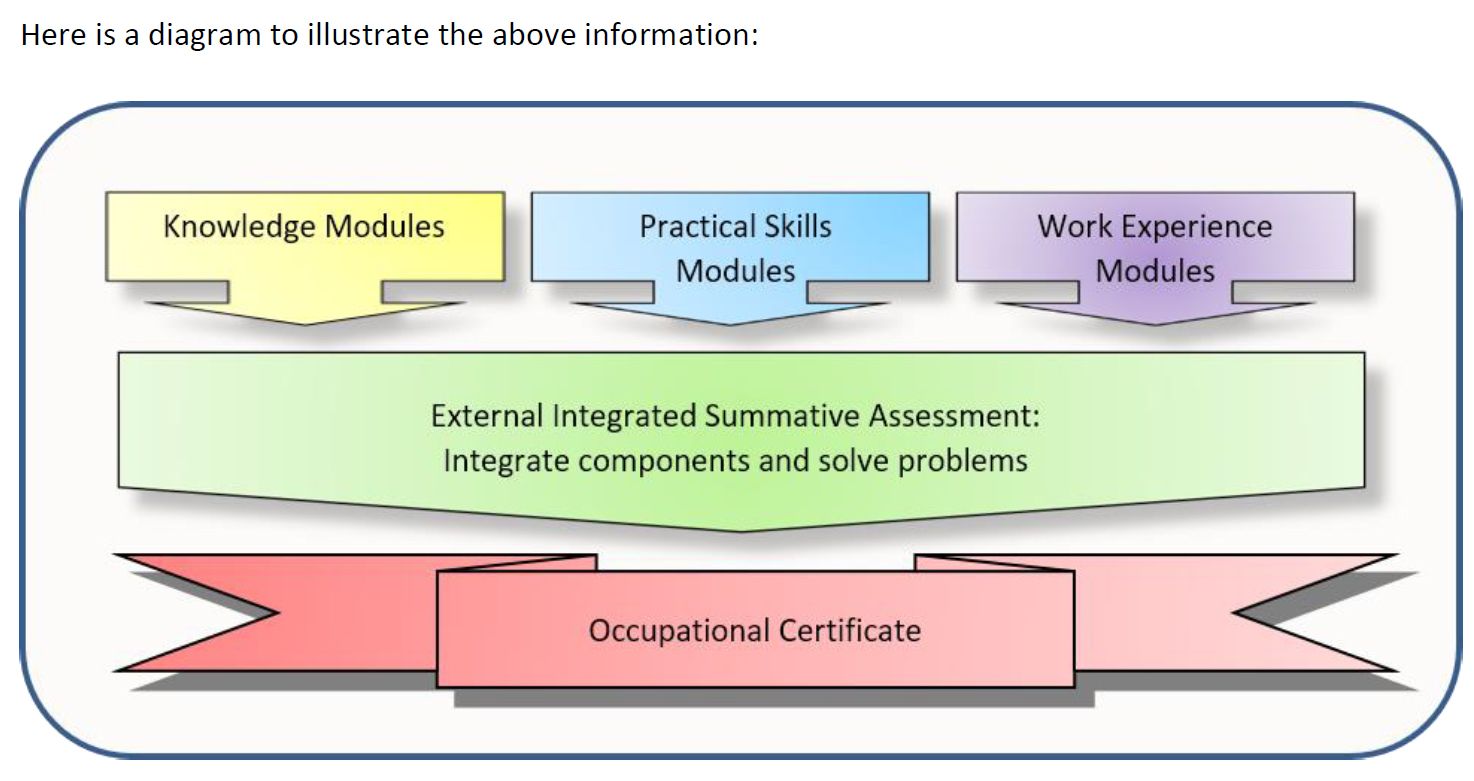
The qualification specifies the competencies that you should gain proficiency in during the learning programme. It also specifies the assessment criteria for the final assessment. More information on assessment follows.
- Originate and pitch content ideas
- Report by gathering information and materials
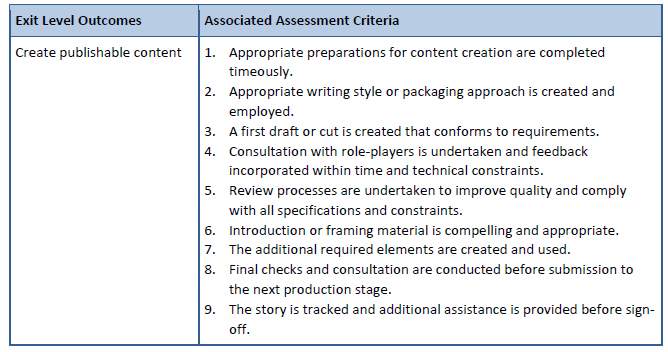
- Create publishable content
By completing this qualification, you will be required to display general knowledge, understanding, skills and competencies required of a journalist. These competencies are specified in the Exit Level Outcomes and the Associated Assessment Criteria in the table below.

Module Alignment
Each of the three components in the qualification has a number of modules. You will have to complete all the modules and be found competent in all the modules to be eligible for the final assessment. Here is a list of all the modules:


Credits
You will notice that each of the modules has a credit value. The total credit value for the qualification is 193. The total duration to complete the qualification is a year.
The credit value of a module acts as a guide to how long it should take you to complete it. The formula is: 1 credit = 10 notional (learning) hours.
For example, if a module is 4 credits, it would take 40 hours to complete – a workday consists of 8 hours – therefore 5 days (one week) to complete the module.
Learning is made up of the hours spent in actual training (contact), practical exercises, workplace experience, self-study and preparation for assessment or any other time spent to become competent.
Entry Requirements
To be able to enrol for this learning programme, you will have to show evidence of one of the following entry requirements:
- Any NQF Level 4 Qualification with Computer Literacy
Learner’s Guide
You will receive a single Learner’s Guide which covers all the modules in the qualification. It contains instructions and explanations on the activities and exercises that you have to complete.
During the programme, developmental activities will be conducted to assist you in preparing for the final assessment. For your own benefit, make sure that you participate fully in all the developmental and formative assessment activities.
- Assessment is a way of measuring what you know and are able to do.
- You may be assessed when you are sure that you are ready to be assessed. If you do not achieve the standard the first time, you can be coached or trained further and to be re-assessed at a later stage. You will be assessed in a number of ways and at regular intervals.
- Make sure you are familiar with the Assessment Guide. Start preparing and collecting evidence from the onset of the programme.
- There are three types of assessment which is explained in detail below.
Internal Formative Assessment
Internal formative assessment will happen on a continuous basis and is directly linked to the modules in the qualification and work that you will be doing in the classroom or during the practical demonstrations and activities. This will be in the form of exercises and checklists in the Learner’s Guide, which will be assessed by your facilitator. The aim of the formative assessment is to keep track of your progress throughout the learning programme.
- Please ensure that you complete and submit all the activities or checklists as indicated by your facilitator.
- The activities in this Learner’s Guide are designed not only to develop your competence, but also to prove that you have mastered competence.
Internal Summative Assessment
The aim of the internal formative assessment is to determine whether you are competent/not yet competent. If found competent you will be issued with a Statement of Results (SoR) per module.
- The internal formative assessment will be conducted upon completion of each knowledge and practical skills module.
- This will include a theoretical assessment for the knowledge and practical skills modules, as well as a practical demonstration for the practical skills modules.
- Your assessor and you will conduct a pre-assessment meeting to discuss the assessment process and how you will collect evidence of your competence. When you are ready, you will advise your assessor that you are ready for the assessment
External Integrated Summative Assessment (EISA)
- Before certification can take place, you will be assessed externally. The External Integrated Summative Assessment (EISA) will take place after you have been found competent and have received a Statement of Results for the knowledge modules.
- You must have similarly been found competent in lieu of the practical modules and have received a statement of results (SoR) for each practical skills module.
- Finally, you must have completed and submitted a fully signed off logbook documenting all workplace experience. Only once competence has been achieved across all three of the aforementioned components, will you gain entry into the EISA.
- The EISA will be administered by the Assessment Quality Partner (AQP) who in the case of this qualification is the Fibre, Processing and Manufacturing Sector Education Training Authority (FP&M Seta).
Summary
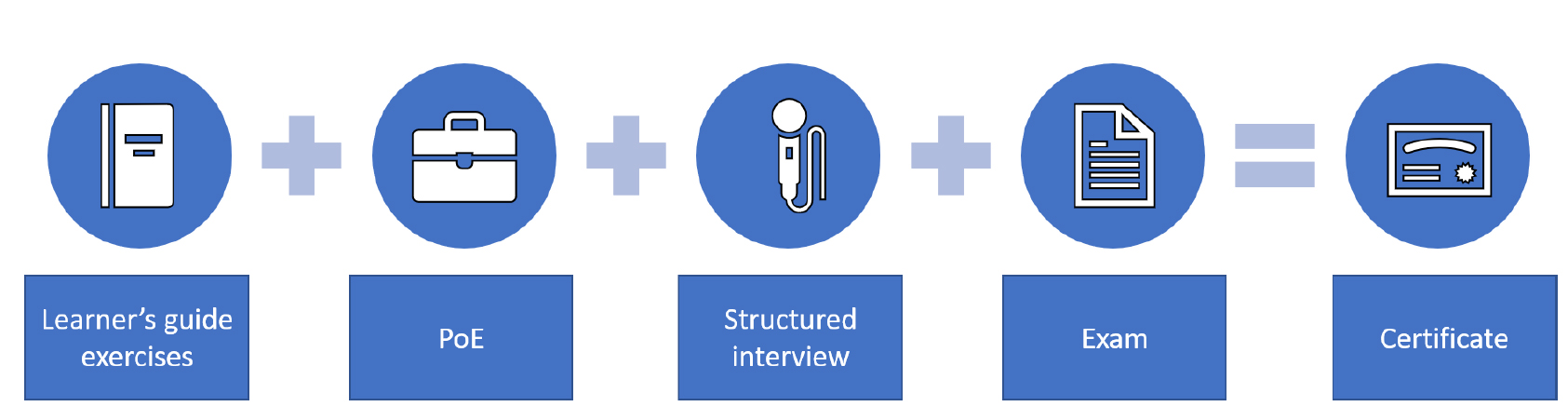
In order to be competent and achieve the qualification, you will need to complete four components. The formative and summative assessments in the this guide, the PoE (guidelines are in this guide) and the exam (at a testing centre), at which time the you will be interviewed on the contents of your PoE.
RPL Assessment
- There is a recognition of prior learning (RPL) option available for learners who have previously been team leaders, and who do not wish to attend all training sessions.
- As RPL is based primarily on historical evidence, the option of RPL assessment is available on assumption that the learner has met the minimum literacy and numeracy requirements and has spent time in a newsroom environment.
- The RPL options are based on the same structure as this learning programme – your application will, therefore, be based on all the specific outcomes and assessment criteria that form the full unit standard.
Learner Support
Please remember this programme is outcomes based – this implies the following:
- You are responsible for your own learning – make sure you manage your study, practical, workplace and portfolio time responsibly.
- Learning activities are learner-driven – make sure you use the Learner’s Guide and readings in the manner intended and are familiar with the assessment requirements.
- The facilitator is there to reasonably assist you during contact, practical and workplace time of this programme – make sure that you have his/her contact details.
Attendance Register
You are required to sign the attendance register every day of attendance. Please make sure you sign daily!
Programme Evaluation Forms
Please complete the form before the end of contact sessions, as this will assist us in improving our service and programme material. Your assistance is highly appreciated!
Conclusion
You are now ready to start your training on the Occupational Certificate: Journalist. Remember this qualification is pitched at NQF Level 5 and will earn you 139 credits.
Last modified: Tuesday, 16 May 2023, 9:45 PM