
Page
Chapter Two: Knowledge Module Two The legal and ethical framework for the media
Completion requirements

Chapter Two: Knowledge Module Two The legal and ethical framework for the media
In this chapter
- The purpose of this module
- The learning outcomes of this module
- The components of this module
- The content in this module includes:
- Law, conventions and agreements affecting media (including Chapter 9 Institutions, freedom of expression and information, relevant laws and bodies impacting journalistic practice and the landscape)
- Ethics (including principles, decision making, credibility, inducements and reputation management)
- Self-assessment
Module Purpose
The main focus of the learning in this knowledge module is to build an understanding of media law and ethics.
The learning will enable learners to demonstrate an understanding of:
- KM-02-KT01: Law, conventions and agreements affecting media (50%)
- KM-02-KT02: Ethics (50%)
Module Details
Module Content
Welcome to the second module of the occupational certificate in journalism. Under this module, we'll look at both the legal environment and the ethical environment in which journalists function. There are constitutional provisions and laws that you need to be aware of. Journalists, because of their job, may be more likely to face charges of defamation and we will discuss this. We will also look at reporting rights and responsibilities, reporting on court cases, protecting sources, particular responsibilities during elections, and regulatory bodies in South Africa. While the legal responsibilities of a journalist and the ethical responsibilities of the journalist align to some degree there are also notable points of divergence and we will discuss the legal environment in which you will work.
Law, conventions and agreements affecting media
There are many laws and bodies that impact the practice of journalism in South Africa. There are laws that you, as a journalist may contravene in your everyday practice, which you need to be aware of in order to ensure that you do not. There are also laws that can help you perform your duties as a journalist by allowing you to access information and legally protect your sources.
This section will cover:
- Freedom of expression, freedom of information; responsibility; intersecting rights; hate speech (the Bill of Rights and the Constitution of the Republic of South Africa)
- Chapter 9 institutions
- Protection of Personal Information Act, 2013 (POPI Act) and the Promotion of Access to Information Act, 2000 (PAI Act)
- Defamation
- Reporting rights and responsibilities on assignment
- Reporting on court proceedings (restrictions in reporting; Criminal Procedures Act, 1977; contempt of court)
- Protection of sources and the law
- Elections reporting, regulations and agreements
- Regulatory bodies
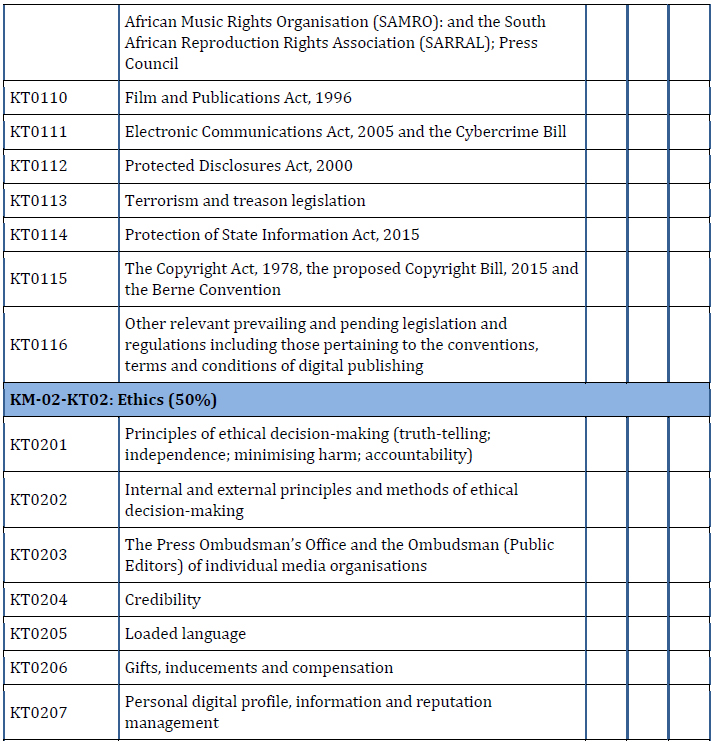
- Film and Publications Act, 1996
- Electronic Communications Act, 2005 and the Cybercrime Bill 2016
- Protected Disclosures Act, 2000
- Terrorism and treason legislation
- Protection of State Information Act, 2015
- The Copyright Act, 1978, the proposed Copyright Bill, 2015 and the Berne Convention
- Other relevant prevailing and pending legislation and regulations, including those pertaining to the conventions, terms and conditions of digital publishing

Freedom of expression, freedom of information; responsibility; intersecting rights; hate speech (the Bill of Rights and the Constitution of the Republic of South Africa)
The highest law in South Africa is the Constitution of the Republic of South Africa (1996). All other law should be in line with the Constitution. Chapter 2 of the Constitution is the Bill of Rights details the various rights all South Africans are entitled to.
The Bill of Rights enshrines the right of freedom of expression for all people in South Africa. Section 16 notes:
(1)Everyone has the right to freedom of expression, which includes -
(a)freedom of the press and other media;
(b) freedom to receive or impart information or ideas;
(c) freedom of artistic creativity; and
(d) academic freedom and freedom of scientific research.
However, freedom of expression is not absolute. It is limited to by (according to the same section):
(2) The right in subsection (1) does not extend to -
(a) propaganda for war;
(b) incitement of imminent violence; or
(c) advocacy of hatred that is based on race, ethnicity, gender or religion, and that constitutes incitement to cause harm.
In other countries like the United States the right to freedom of expression is above all other rights. This is not the case in South Africa; the right to freedom of expression has not been elevated above other rights in South African law.
Milo and Stein write in A Practical Guide to Media Law (2013):
In South African law the right to freedom of expression must be balanced with other rights such as that to human dignity.
Not only human dignity, but as Yvonne Burns writes in Communications Law (2004):
[The right to freedom of expression] must be read, interpreted and understood in the light of other competing and potentially conflicting rights (which are also constitutionally protected) such the rights to equality, dignity and privacy, or potentially complementary rights such as the right to freedom of religion, belief and
opinion and the rights of assembly, demonstration, petition, association and access to information.
Any limitation on freedom of expression other than the limitations expressly justified in terms of section 16(2) must be tested in terms of the general limitations clause of the Constitution, namely, Section 36:
The rights in the Bill of Rights may be limited only in terms of law of general application to the extent that the limitation is reasonable and justifiable in an open and democratic society based on human dignity, equality and freedom, taking into account all relevant factors, including—
(a) the nature of the right;
(b) the importance of the purpose of the limitation;
(c) the nature and extent of the limitation;
(d) the relation between the limitation and its purpose; and
(e) less restrictive means to achieve the purpose.
(2) Except as provided in subsection (1) or in any other provision of the Constitution, no law may limit any right entrenched in the Bill of Rights.
Chapter 9 institutions
Please do the Assignment No 01
Chapter 9 institutions find themselves in a rather difficult position. They have to hold the legislative and executive arms of government to account, while at the same time being accountable to the National Assembly, which forms part of the legislative arm; and being dependent on funding over which the executive has control. For these reasons, Chapter 9 institutions are independent but not to the extent that the judiciary is.
Constitutional law expert Pierre de Vos says: “They [Chapter 9 institutions] have to tread carefully to ensure the cooperation of the legislature and the executive while at the same time safeguarding their independence and, where necessary, criticising and even challenging executive or legislative actions.”
Section 14 of the Bill of Rights says that:
Everyone has the right to privacy, which includes the right not to have—
(a) their person or home searched;
(b) their property searched;
(c) their possessions seized; or
(d) the privacy of their communications infringed.
Private facts have been described by the constitutional court as:
those matters of disclosure of which would cause mental distress and injury to anyone possessed of ordinary feelings and still agents in the same circumstances and in respect of which there is a will to keep them private. The following categories of information examples of private facts:
health medical information
financial affairs
sexual life
family life and
the contents of private correspondence10
In line with the constitutional right to privacy the Protection of Personal Information Act (4 of 2014) aims:
To promote the protection of personal information processed by public and private bodies; to introduce certain conditions so as to establish minimum requirements for the processing of personal information; to provide for the establishment of an Information Regulator to exercise certain powers and to perform certain duties and functions in terms of this Act and the Promotion of Access to Information Act, 2000; to provide for the issuing of codes of conduct; to provide for the rights of persons regarding unsolicited electronic communications and automated decision making; to regulate the flow of personal information across the borders of the Republic; and to provide for matters connected therewith.
The Act led to the creation of the information regulator. It will apply to every person who processes personal information of another. The Act excludes journalists who process information for journalistic purposes from the purview of the regulator however:
journalists must belong to a professional body that provides adequate safeguards in its code of conduct for the protection of personal information
The Promotion of Access to Information Act, 2000 (PAI Act or PAIA)
The Bill of Rights also makes access to information a right. Section 32 reads:
(1) Everyone has the right of access to -
(a) any information held by the State; and
(b) any information that is held by another person and that is required for the exercise or protection of any rights.
(2) National legislation must be enacted to give effect to this right, and may provide for reasonable measures to alleviate the administrative and financial burden on the state.
The promotion of access to information Act (2 of 2000) gives effect to this constitutional provision.
Journalists can use PAI Act to access the information they need from government and private sources. However, PAIA requests can take a long time and be very costly. Should you want to submit a PAIA request the South African History Archive can help you. Website: http://www.saha.org.za/about_saha/freedom_of_information_programme.htm.
Please answer the Assignment No 03
Defamation

According to Milo and Stein, the right to an unimpaired reputation is in conflict with the right to everyone’s right to freedom of expression. Defamation law tries to balance this tension by allowing individuals to pursue their reputational rights through pre-publication restraint or post-publication lawsuits.
Elements of defamationMilo and Stein (2013) note that defamation can be seen in the ordinary (or obvious) meaning of the article. It may be found where innuendo is used in an article, even if it depends on special knowledge to detect the intended meaning. If material can be paraphrased to be defamatory, the plaintiff could sue for defamation. Headlines can also be defamatory.
The essential elements of defamation that must be proven by the plaintiff are (from Milo and Stein):
- There must be publication
- Of matter that has a defamatory meaning
- The matter must refer to the plaintiff

Burns notes that in the law of defamation, publication means the communication of a defamatory statement — words or actions — to a third person or persons. South African courts test defamation against whether it tends to lower the plaintiff in the estimation of right-thinking persons.
Burns says that the rationale behind the acceptance of strict liability of the mass media for defamation — meaning the media have to prove they have not defamed someone and not vice versa — is based on the need to protect the individual who found himself in a vulnerable position vis-à-vis the media.
In regard to defamation, journalists have what is termed qualified privilege. This allows journalist to publish or broadcast statements that would be considered defamatory, within certain limits (as above). Qualified privilege is also extended to legal counsel, attorneys, witnesses and litigants during legal proceedings, although such persons are seldom charged with defamation. This can be contrasted with absolute privilege which applied to proceedings in parliament. Absolute privilege allows for statements in parliament that would otherwise be defamatory and could result in a charge of defamation.
Reporting on court proceedings
Journalists have the right of access to court proceedings: the right to open justice, or “the right of the public to access court proceedings” is often exercised by the media on behalf of the public. For practical reasons, members of the public generally rely on the media to inform them of what happens in various courts. Reporters therefore have a right to attend proceedings except when a judicial officer rules that it must be held in camera. This is true in criminal trials and civil matters.
Section 5 of the Child Care Act (74 of 1983) provides that every magistrate’s court is a children’s court for the area of jurisdiction. No one may be present at a sitting of a children’s court unless his or her presence is required for the proceedings. Burns notes that Section 8(3) provides that no person may publish information relating to the proceedings in a court of law which may reveal the identity of the child involved. Similarly, no person is allowed at maintenance courts unless their presence is necessary.
Through Section 62 (7) of the High Court rules, anyone who has cause has the right to inspect court records. However, a reporter does not have a right of access to court records where a matter has not yet come before courts.
Everyone is entitled to publish a fair account of judicial proceedings in open court. According to Burns:
“Under the 1996 Constitution the courts are the guardians of individual rights laid down in the Bill of Rights. Both print and broadcasting media can and should play a major role in informing the public if the extent of these rights as well as their protection by the courts”.
There are, however, some restrictions when reporting court proceedings:
- The publication of any information whatsoever, which reveals or may reveal the identity of any person under the age of 18 years who is either an accused or witness in a criminal trial, is prohibited.
- In terms of Section 153 (2) of the Criminal Procedure Act, the court may rule that certain witnesses may not be identified.
- Section 154 (2)(b) prohibits the publication of any information before the appearance of an accused on a charge of indecency or extortion or after his appearance before he has pleaded to the charge.
- The Divorce Act 70 of 1979 curtails the right of newspapers to report on court proceedings of divorces.
Contempt of court is:
the unlawful and intentional violation of the dignity, repute or authority of a judicial officer in his or her judicial capacity, or of a judicial body, or the unlawful and intentional interference with the administration of justice in a matter pending before a judicial body (quoted in Milo and Stein 2013: 119).
This criminal offence may result from:- Disobeying a court order
- Scandalising the court or “the illegitimate criticism of courts and judges” and
- The sub judice rule, which applies to statements that prejudice the administration of justice in pending proceedings
Please answer the Assignment No 06
Protection of sources and the law
The relationship between journalists and their sources is based on mutual trust. It is governed by the media organisation’s own code of conduct. Reporters often receive confidential information from informants.
“Depending on the circumstances, it may be illegal under Section 205 of the Criminal Procedures Act for you to conceal your sources of information from a police investigation or court of law. However, journalists are acting unethically if they reveal sources: they are breaking the trust of the person who gave them information. They are also endangering any future relationships with potential informants. Again, it can be argued that informants — particularly civil servants sworn to confidentiality — are breaking their trust with the public service and deserve to be named. This is one area where law and ethics clearly clash and is a personal call upon your integrity as a journalist.” Gwen Ansell, Introduction to Journalism.
Milo and Steyn (2013: 112) highlight some important principles that arise from case law for protection of sources, these include:
- A journalist should have an agreement with the source to maintain the confidentiality of his or her identity.
- The source, in disclosing information, must have acted in the public interest and for the public good. The court is more likely to recognise a journalist’s right to protect his/her source if the source has acted in the public interest.
- Each case where a journalist wishes to protect the identity of her/his source must be determined on its own merits.
- In dealing with confidential sources a journalist should follow ethical codes of conduct.
Please do the Assignment No 07
Elections reporting, regulations and agreements
The media has a particular role to play in upholding democracy around elections. During elections, journalists have an obligation to keep citizens informed. In order for journalists to play their role in the best possible way, they need to:
- Have access to electoral processes and politicians
- Ensure that their reporting is accurate
- Report in a balanced, neutral and honest way
- Be independent of political influence
- Consider the rights of citizens, not only to vote, but to have their rights recognised by the candidates.
During elections, journalists should inform the public about:
- The legal framework of elections — what each vote means
- Voter registration
- Election administration
- The candidates and parties in the election
- What happens on election day
- Announcement of results
- Election observers
- Election fraud
The role of the media in elections in South Africa is recognised in the Electoral Code of Conduct, which forms part of the Electoral Act (18 of 2013). It says:
“Every party and every candidate –
1. Must respect the role of the media before, during and after an election conducted in terms of this Act;
2. May not prevent access by members of the media to public political meetings, marches, demonstrations and rallies; and
3. Must take all reasonable steps to ensure that journalists are not subjected to harassment, intimidation, hazard, threat or physical assault by any of their representatives or supporters.”
Media strategist, Mary Papayya, has this advice if you are attacked or harassed by a politician, while reporting on an election:
We must report the incident to the police and make sure there are witnesses. Such incidents are often denied by those responsible. The case is investigated like any other criminal case. Our organisation must cover the story and so must every other news organisation. The editor must report it to the party and send a written notification to them. The Independent Electoral Commission (IEC) and other observer bodies must also be notified so that the correct action can be taken against the person responsible.
Please do the Assignment No 08
Regulatory bodies
The Independent Communications Authority of South Africa (ICASA)
Media regulation can be used to suppress media freedom in a country. For this reason, in South Africa and other countries, media have been party to the establishment of regulatory bodies. For broadcast media — where bandwidth is finite and a public asset —, media regulation is necessary. For print and online media regulation by government authorities can represent a threat to media freedom. In this section we will look at the various regulatory bodies in South Africa.
According to the ICASA website:
ICASA is responsible for regulating the telecommunications, broadcasting and postal industries in the public interest and ensure affordable services of a high quality for all South Africans. It also issues licences to telecommunications and broadcasting service providers, enforces compliance with rules and regulations, protects consumers from
unfair business practices and poor quality services, hears and decides on disputes and complaints brought against licensees, and controls and manages the effective use of radio frequency spectrum.
Our focus areas are the following:
BROADCASTING
We develop regulations for the broadcasting industry, issue licences to service providers, plan and manage the radio frequency spectrum, and protect consumers against poor-quality services.
LICENSING
ICASA's Licensing and Compliance Division is responsible for the licensing of broadcasting services (including community, commercial, public and subscription) and electronic communications services. We are further responsible for monitoring and ensuring the compliance of these broadcasting and electronic communications services.
ELECTRONIC COMMUNICATION
In terms of telecommunications, our main responsibilities relate to licensing, consumer protection and telecommunication numbering.
POSTAL SERVICES
ICASA has to licence and monitor the South African Post Office in relation to customer-care standards and universal service obligations. This includes the roll-out of street addresses and the provision of retail postal services in under-serviced areas.
Website: https://www.icasa.org.za/
The Broadcasting Commission must make sure that everything that is on television and radio is fair and does not discriminate against anybody. If someone feels that a broadcaster is not abiding by the code of conduct, they can complain to this commission.
The website says:
The BCCSA as an Independent Judicial Tribunal
The Broadcasting Complaints Commission of South Africa (“BCCSA”) was established by the National Association of Broadcasters (“NAB”) in 1993. According to the BCCSA’s Constitution it is a body corporate, capable of suing and being sued in its corporate name, and of performing all such acts as are necessary for or incidental to the carrying out of its objects, and for the performance of its functions and duties under its Constitution.
The BCCSA shall be based in Johannesburg but the Chairperson may, when he or she deems it appropriate, decide to hold a session of the Tribunal of the Commission at any place in South Africa. The BCCSA was recognized by the Independent Broadcasting Authority (“IBA”, now ICASA) in 1995 in terms of section 56(2) of the IBA Act 1993. During these hearings before the IBA, the IBA emphasised that the BCCSA must be an independent judicial tribunal so that it could, without fear or favour, adjudicate complaints from the public against the broadcasters, which are members of the NAB.
Website: http://www.bccsa.co.za/
The Press Council is an independent co-regulatory body, meaning that members of the media and the public oversee regulation in the country. It decides on complaints against newspapers and online news publications, based on a code of conduct.
According to the website:
According to the website:
The Press Council, the Press Ombud and the Appeals Panel are an independent co-regulatory mechanism set up by the print and online media to provide impartial, expeditious and cost-effective adjudication to settle disputes between newspapers, magazines and online publications, on the one hand, and members of the public, on the other, over the editorial content of publications.
The mechanism is based on two pillars: a commitment to freedom of expression, including freedom of the media, and to high standards in journalistic ethics and practice.
The Council has adopted the South African Press Code to guide journalists in their daily practice of gathering and distributing news and opinion and to guide the Press Ombud and the Appeals Panel to reach decisions on complaints from the public. Member publications subscribe to the Press Council's Code of Ethics and Conduct for SA Print and Online Media..
The Council is the custodian of this Code and may amend it from time to time, depending on needs.
The Southern African Music Rights Organisation (SAMRO)
According to the website of the Southern African Music Rights Organisation (SAMRO):
SAMRO’s primary role is to administer Performing Rights on behalf of our members. We do so by licensing music users (such as television and radio broadcasters, live music venues, retailers, restaurants, promoters and shopping centres), through the collection of licence fees which are then distributed as royalties.
Website: http://www.samro.org.za
Film and Publications Act, 1996
Electronic Communications Act, 2005 and the Cybersecurity and Cybercrime and Bill
The Film and Publications Act (65 of 1996) regulates films including visual images printed materials and games which contains sexual content, propaganda for war incitement to violence and hate speech. They are the body that is responsible for determining age restrictions on films and games.
Newspapers and magazines that subscribe to the Code of Conduct of the Press Council are exempted from the requirement of having to submit material for classification. The Film and Publications board can ban films, games and publications, which contain child pornography, propaganda for war, incitement of violence and hatred.
Source: Milo and Stein 2013: 142, 143
The Electronic Communications Act (36 of 2005) was written to (according to the Act itself):
To promote convergence in the broadcasting, broadcasting signal distribution and telecommunications sectors and to provide the legal framework for convergence of these sectors; to make new provision for the regulation of electronic communications services, electronic communications network services and broadcasting services; to provide for the granting of new licences and new social obligations; to provide for the control of the radio frequency spectrum; to provide for the continued existence of the Universal Service Agency and the Universal Service Fund; and to provide for matters incidental thereto
The Cybercrimes and Cybersecurity Bill has not yet been passed by Parliament, it has been very controversial as some provisions have threatened free speech on the internet. As a general rule, speech should not be criminalised under law as there should be sufficient civil penalties. It aims (according to the Bill gazetted on 31 August 2018):
To create offences and impose penalties which have a bearing on cybercrime; to criminalise the distribution of data messages which is harmful [sic.] and to provide for interim protection orders; to further regulate jurisdiction in respect of cybercrimes; to further regulate the powers to investigate cybercrimes; to further regulate aspects relating to mutual assistance in respect of the investigation of cybercrime; to provide for the establishment of a 24/7 Point of Contact; to further provide for the proof of certain facts by affidavit; to impose obligations on electronic communications service providers and financial institutions to assist in the investigation of cybercrimes and to report cybercrimes; to provide for the establishment of structures to promote cybersecurity and capacity building; to regulate the identification and declaration of critical information infrastructures and measures to protect critical information infrastructures; to provide that the Executive may enter into agreements with foreign States to promote cybersecurity; to delete and amend provisions of certain laws; and to provide for matters connected therewith.
The Protected Disclosures Act (26 of 2000) makes it possible for an employee to disclose questionable activities of their employer. According to the Act, it is:
To make provision for procedures in terms of which employees in both the private and the public sector may disclose information regarding unlawful or irregular conduct by their employers or other employees in the employ of their employers; to provide for the protection of employees who make a disclosure which is protected in terms of this Act; and to provide for matters connected therewith.
It is to ensure that those blowing the whistle are not penalised by their employer. Journalists are not explicitly mentioned in the Act as a person to whom the disclosure may be made, but when other routes are not successful, a person may well disclose to you.
Terrorism and treason legislation
The Protection of Constitutional Democracy Against Terrorist and Related Activities Act 33 OF 2004 aims (according to the Act):
To provide for measures to prevent and combat terrorist and related activities; to provide for an offence of terrorism and other offences associated or connected with terrorist activities; to provide for Convention offences; to give effect to international instruments dealing with terrorist and related activities; to provide for a mechanism to comply with United Nations Security Council Resolutions, which are binding on member States, in respect of terrorist and related activities; to provide for measures to prevent and combat the financing of terrorist and related activities; to provide for investigative measures in respect of terrorist and related activities; and to provide for matters connected therewith.
The Act makes it the duty of anyone to report it if they know that someone has or will commit a terrorist act. It also makes provision for stopping and searching of property as well as seizing of property believed to have information about terrorist activities. Similarly, the Defence Act 42 of 2002 also makes
reference to classified information which cannot be shared. This Act refers particularly to the information of the Department of Defence.
High treason is an offence not covered by an Act, but what is called ‘common law’, or law that is created in the courts, rather than through parliamentary procedures. According to the SAPS website, high treason:
… consists of any conduct unlawfully committed by a person owing allegiance to a state with the intention of:
Protection of State Information Act, 2015- overthrowing the government of the Republic;
- coercing the government by violence into any action or inaction;
- violating, threatening or endangering the existence, independence or security of the Republic;
- changing the constitutional structure of the Republic.
In the interests of national security, the Protection of State Information Act (2015) requires that some matters be classified as confidential, secret or top secret. It is classified as such by the head of the organ of state or a delegated senior member of staff. Journalists who receive government information that is not marked as classified are entitled to assume that is not classified. It is possible to request that a document be declassified.
The Copyright Act, 1978, the proposed Copyright Bill, 2015 and the Berne Convention
Please do the Assignment No 12
South Africa is signatory to the Berne Convention adopted in 1886, which protects an author or creator’s rights to say how they will have the work used by whom and on what terms13. The Copyright Act of 1979 (subsequently amended on multiple occasions) protects works including literary artistic and music works, films, sound recordings, and computer programmes. In order to be copyrighted, a work must be original and reduced to a material form. Original works do not have to be based on new ideas or thoughts but involve skill, effort and labour. Sentences and slogans can also be copyrighted. Copyright lasts for 50 years, after which the work is made available to the public.
Protection of the copyright is applied first and foremost to the author of a work, however when the work is produced in the course of one’s employment the proprietor or employer will be the copyright owner. This means you as a journalist working for a publication will not own the copyright to your own work as a matter of course.
Ethics
Given journalists’ role in society to provide access to the right to information and expression, it is important that journalists maintain the highest ethical standards when reporting. As you have seen from the law section, law and journalistic ethics do not always align. For journalists, the study of ethics is not an abstract branch of philosophy but includes practical guidelines on professional practice. This section covers the principles and institutions of ethics for South African journalists.
This topic accounts for 50% of this module.
Franz Kruger author of Black, White and Grey: Ethics in South African Journalism14, notes that ethics is about right and wrong and it’s been around much longer than journalism or media or even the written word. The law, however, sets the minimum standards to which we must adhere or face the consequences in court.
As a field of philosophical inquiry, it (ethics) deals with morality, moral judgements and the meaning of concepts like right and wrong. At a more practical level, it considers what should be done in particular situations. As such, it is clearly distinct from the law. Where ethics sets the highest standards of ideal behaviour, the law is concerned with the minimums, with ‘the bottom line below which we should not fall’…
- Doing ethics in Journalism, a highly influential book by three American ethicists, Jay Black, Bob Steele and Ralph Barney15:
The law, of course, carries sanctions of a more vigorous kind than any ethical code whereas ethics appeals to the journalist’s own responsibility and conscience. In these ways, the approach taken by the two disciplines is fundamentally different even though many issues are addressed in both law and ethics: privacy is an example, as is the naming of children in certain circumstances.
Please do the Assignment No 13
Minimising Harm
If truth-telling is the principle that drives us forward, says Kruger, this is the consideration that sometimes puts on the brakes.
We have to recognise that people can get hurt by journalism: dealing with reporters can deepen the trauma suffered; reputations can suffer; people can be subjected to ridicule, recriminations and even physical danger; and public sensitivities can be offended. These things are not always avoidable — sometimes they are even necessary. But we should be aware of the potential harm and try to minimise it.
Accountability
Journalists should be prepared to explain and answer for their work, to their audiences and to the public at large, says Kruger.
This is done in the handling of readers’ letters, published corrections, and co-operation with the systems of self-regulation. These sorts of things build trust with audiences. They are very different from state regulation, which would undermine media freedom.
Broadcasters sometimes have feedback systems in the form of letters from listeners. Now, print, broadcast and online all have avenues of feedback in the form of social media accounts.
Public interest or interesting to the public?
Kruger also asks whether something is in the public interest. The issue of public interest plays a central role in grappling with ethics. Often, it is the key to settling particular dilemmas. He warns, however, that while the courts recognise public interest, it remains an imprecise tool.
A distinction is often made between public interest and that which merely interests the public. The Press Code says:
The media's work is guided at all times by the public interest, understood to describe information of legitimate interest or importance to citizens.
This does not include information about which the public may like to know about, that has no impact on their lives or relate to the private lives of public people and does not impact public policy or practice.
Kruger acknowledges that ethical principles sometimes conflict. He writes:
In fact, most ethical dilemmas arise when different ideals pull us in different directions. If things were always simple and straightforward, there would be little to say about ethics. We should not be afraid of these dilemmas and complexities but should confront them honestly.
Internal and external principles and methods of ethical decision-making
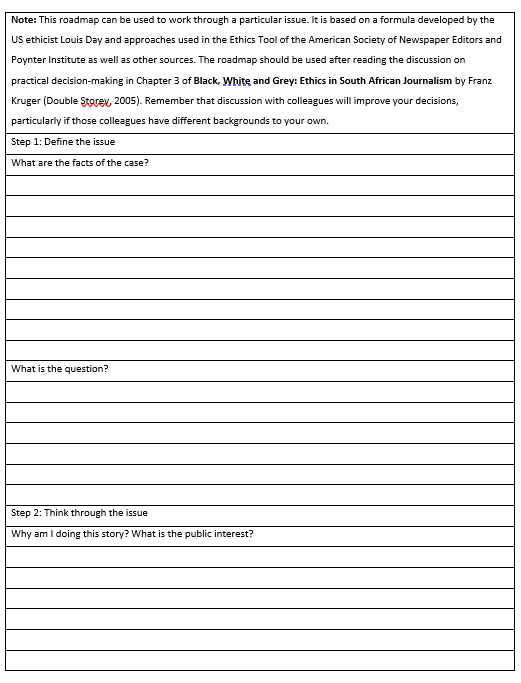
There are broadly two ethical approaches you can take when faced with a dilemma. The first you may call an “endpoint” approach this allows you as a journalist to weigh the impact of the story or technique. It is a popular approach, however:
- behaviour to reach an end state in the short-term may cause harm or violate some ethical principles
- it can result in the privileging the interests of majorities over legitimate minorities
It also assumes that you are correct in predicting the final result.
A second approach can be considered a “duty-based” approach. It asks of the situation: what are my obligations? It requires a set of rules that can be referred to. This approach avoids some pitfalls, but it can be rigid.
Anyone can pick up a pen, write a story and call themselves a journalist. Journalists are generally not required to register or join professional associations, because of the high value accorded to freedom of expression and the fact that media freedom is generally prized because of its role in society holding government to account. However, to prevent governments from attempting to regulate media heavily, journalists need to be ethical in their reporting.
The Society of Professional Journalists (SPJ) has these principles in their code:
- Seek the truth and report it
- Minimise harm
- Act independently
- Be accountable and transparent
It is the journalist’s integrity and personal ethics that guide decisions. In many cases, nobody may even know about the decisions you make. Your internal compass will guide you. It is best to decide before entering a situation what you're prepared to do, so you're not forced to make a decision in a stressful, pressurised moment. In the field, ethical decisions are often taken under pressures including deadlines. Reading or watching case studies can help you decide on how you will act should circumstances arise.
There are also norms for ethical behaviour in your newsroom. These are external principles. Ideally, the external principles and internal principles should align. In real life, both internal and external considerations are often considered at the same time.


The Press Council and the ‘Ombuds’ (Public Editors) of individual media organisations
Credibility
According to Johan Retief in Media Ethics:
An introduction to responsible journalism16: Integrity is what you think of yourself, credibility is what other people think of you.
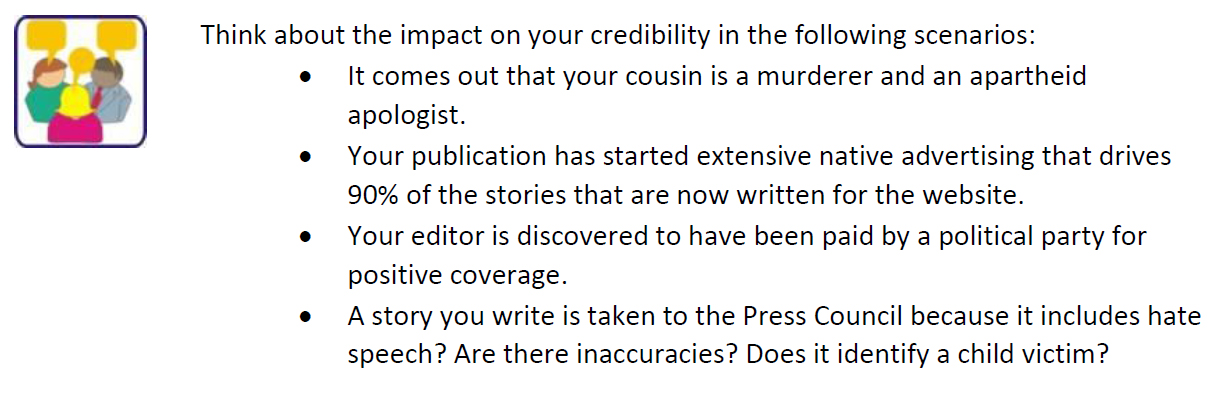
Following ethical principles lends credibility to your work, which in turn build the credibility of your publication or programme. Inaccurate reporting is the quickest way to undermine your credibility. In the context where free content is everywhere credibility is critical for publications, news programming and for journalists to survive. Credibility is what sets you apart as a professional journalist.
Loaded language
Please do the Assignment No 16
The words you choose matter. There are many cases where the words you choose can change your audience’s idea of what is happening. For example, when is the shooting a terrorist attack? How many foreigners constitute an influx, a deluge, a flood? Could you use similar words to discuss business people and homeless people? Many words come with subtle class, racial or gendered stereotypes. Simply repeating the words that politicians use can subtly promote their arguments. Pick your words carefully to ensure that you are not distorting your story.
Gifts, inducements and compensation
Gifts, inducements and compensation represent conflicts of interest and can undermine your capacity to undertake ethical, independent journalism.
When journalists accept favours, gifts or other special considerations from vested interest or new sources, it raises questions about their objectivity17.
In other words, the act of accepting a gift undermines your credibility and can make the giver and other people believe that your Independence has been compromised. For these reasons, newsrooms may require that you hand in anything you receive in the course of reporting. Some gifts may appear in the form of hotel stays, payment for transport or even a meal or drinks. Your newsroom should have guidelines on these.
Remember, even if there are no strings attached initially, such gifts may be used to pressure you in the long-term. Rather refuse gifts or hand them in as per your newsroom policy. Your publication’s code of conduct will have guidelines on such issues, as does the Press Code, which says:
The media shall:
The media shall:
2.1 not allow commercial, political, personal or other non-professional considerations to influence reporting, and avoid conflicts of interest as well as practices that could lead readers to doubt the media’s independence and professionalism;
2.2 not accept any benefit which may influence coverage;
2.3 indicate clearly when an outside organisation has contributed to the cost of newsgathering; and
2.4 keep editorial material clearly distinct from advertising and sponsored events.
Money should have no place in the gathering and telling of stories. Journalists should not accept money to do stories on particular individuals or companies and they should not pay sources for information without the express permission of their editor. Journalists also need to be careful about moonlighting as it can compromise their independence.
Please do the Assignment No 17
Journalists now leave digital trails of their work and all their online activity. A small incident that undermines your credibility can follow you for the rest of your career, undermining your future career opportunities. And with the social media, online reputation management can be even more difficult. Some journalists try to keep their private lives away from their professional digital accounts, but this is very difficult and anything on the private account may end up impacting a journalist’s reputation or depending on the kind of work she or he is doing, even their safety or the safety of loved ones.

Last modified: Wednesday, 17 May 2023, 2:10 AM