
Page
Chapter Four: Knowledge Module Four Origination and pitching of content ideas
Completion requirements
Chapter Four: Knowledge Module Four
Origination and pitching of content ideas
In this chapter
- The purpose of this module
- The learning outcomes of this module
- The components of this module
- The content under this module, which include:
- News – definition, values, criteria, sources
- Specialist journalism — resources, approaches, protocols
- Origination of content ideas — tools, sources, selection
- Developing and delivering a pitch — preparation, delivering, receiving a brief
- o Audiences/users, research methods, research tools
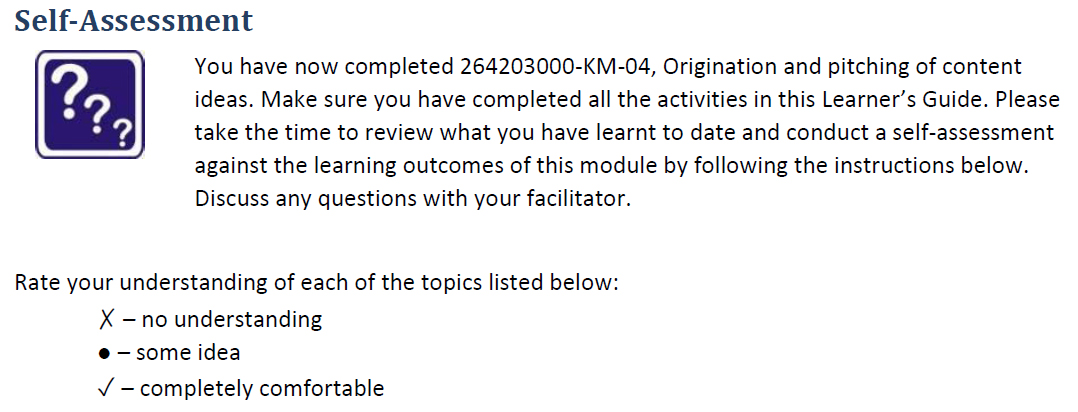
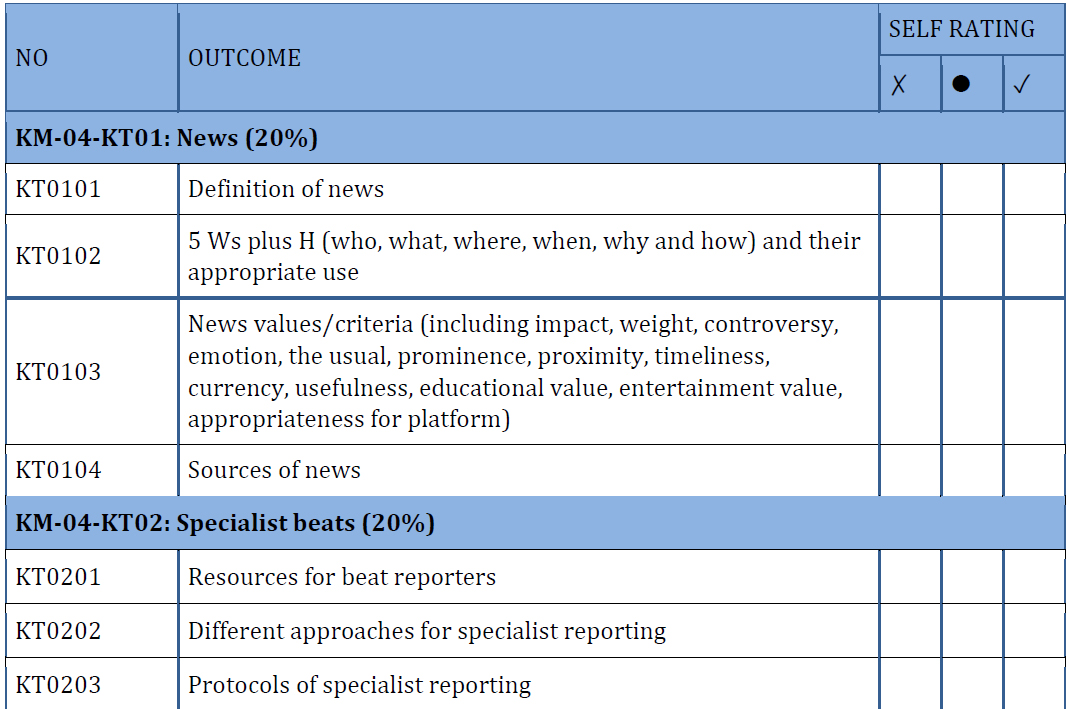
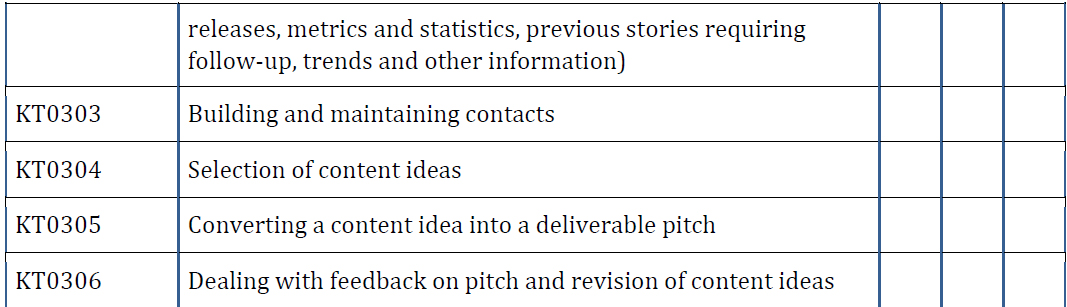
- Self-Assessment:
Module Purpose
The main focus of the learning in this knowledge module is to build an understanding of media, the activities and the personnel of the newsroom, the method of originating ideas, gathering information, analyzing and synthesizing the information and developing a pitch.
Module Details
Module Content
Welcome to module four of the occupational certificate journalist. In this module you will understand what makes news “news”, how to think up content ideas and deliver a story pitch. News values are at the heart of what we do in journalism and whether you are on a news beat or you are a specialist journalist you need to understand how news values work and how this will lead to some content being prioritised over others. We will also look at specialist reporting. Then we will examine tools and sources for Content ideas, this includes building and maintaining contacts. The final section covers how to prepare a story pitch for delivery and how to deliver it.
News
In this section, we’ll look at what news and newsworthiness are, before looking at some sources of news. The understanding of these concepts is critical to the practice of journalism. This topic counts for 20% of the module.
Every day, when we read the news online or in a newspaper, listen to our radio news or watch the television news, we read, hear and watch “news”. Why were these stories chosen? Can you describe what makes news? Are the stories highlighted by your news organisation the same as other news organisations? What makes them different?
Graham Greer describes news as a relative concept but identifies two aspects of news as especially important:
“Firstly, news must be new, i.e. new to those who hear it for the first time. Secondly, news is “any printable story which in the opinion of the editor, will interest the readers of his paper (or the audience of his broadcast).”36
A key thing about news is that it should be out of the ordinary, The News Manual gives these criteria:
- Is it new?
- Is it unusual?
- Is it interesting or significant?
- Is it about people?
Ensure you understand what makes news by reading Chapter One of The News Manual https://www.thenewsmanual.net/Manuals%20Volume%201/volume1_01.htm
“News selection decisions are influenced by three fundamental biases of journalism: immediacy, interest for a given community and significance.”37
“Journalists look to a set of news values to help them determine the newsworthiness of events. These values are: Timeliness; Impact, consequence or importance; Proximity to readers and listeners; Conflict; The unusual nature of the event; Currency, the sudden interest people have in an ongoing situation; At least three-fourths of all stories fall into the categories of impact or importance and the unusual.”
Gwen Ansell says that traditionally, news has been defined by reference to a predetermined set of values which might include novelty, importance, interest, timing, size, proximity, familiarity, surprise, results, relevance, personalities, power, bad news and conflict, availability and marketability.
News editors consider these values when selecting story ideas from journalists. They also inform the placement of news items. For instance, it does not make sense to hide the lead story at the end of a radio bulletin. You want people to be interested and pay attention to the bulletin.
The number of people whose lives will be affected by the subject of the story and how seriously they are impacted. For instance, a theft of power cables that disrupts services to a small suburb has less impact than one that impacts a mine and forces the mine out of operation.

The weight of a story includes the impact (how many and how seriously people are impacted), but it also takes into consideration the depth of pain, the shock factor or “the unusualness” or “unexpected” something might be. For instance, the ward councillor is arrested for cable theft of cables feeding a suburb.

Events or issues can become controversial if they spark arguments, debates, charges, counter charges, and/or fights. For instance, the party to which the ward councillor belongs alleges political motives in the arrest of the ward councillor.

Events are more newsworthy when they touch our emotions. For instance, the closing of the mine story includes interviews with the people impacted, who are unemployed and have little hope of finding other jobs.

This is the degree to which the story is out of the ordinary. For instance, a man biting a dog, vs. a dog biting a man.

The involvement of prominent or famous people in an event makes the event more newsworthy. For instance, a famous musician is implicated in the cable theft.

Stories about events and situations close to home are more newsworthy than events that take place far away. For instance, a girl falls down a well in a village in Limpopo is more newsworthy than a girl falling down a well in Zambia. For the community newspaper in this village, it will be still more newsworthy.

Recent events are far more newsworthy than older events (which may not even qualify as news). Stories that have not previously been shared with the public are more newsworthy than if the public is already aware.

This refers to what people are talking about, for instance issues can ‘trend’ even if they are relatively old. For instance, #metoo brought events to the public eye even though the issue has been a ongoing problem.

Usefulness relates to how useful the information will be to the audience. This is when a story is made applicable to people in their daily lives. For instance, a story on an increase in sugar tax is useful for people to know when they are making purchasing decisions.

The educational value of a story is how more knowledgeable the story makes the audience member. For instance, the story of a girl falling down a well could include information on how the well was constructed and plans to phase out such wells.

This is the value of the story in terms of the capacity to entertain the audience. Stories with elements of sex, relating to show business, that include animals or children that have interesting visuals (if possible) or funny headlines may have greater entertainment value.

Some stories are more suitable for some platforms than other platforms. For instance, a short video may be very good to share on social media while a longer video with more explanation can appear on the main news site.
These are only some news values and you will see how they interact through the self-reflection exercises. You will also notice that some of them overlap. Remember, newsworthy stories can encourage someone to buy, read or watch your news, which raises the chances of this person watching an entire bulletin or reading more of the stories in the paper.
5 Ws plus H and their appropriate use
You may notice from the list of news values that most news values include some sense of negativity. This is why journalists sometimes get a bad rap for only being interested in bad news. Generally, editors deny that they select a story because it is negative. Rather it is because of the news value in the story.
If everything was going fine, if everybody were happy, well-fed, had all their services delivered, there was no corruption and no wasted money there may be nothing to report on. But this is seldom if ever the case. Journalists would not be fulfilling their role as watchdogs if they only told good news.
“Bad news” stories often impact more people. Feel good stories often have a far smaller impact. Negative stories also may be indicative of a bigger problem. For instance, in The Three Little Pigs, the Big Bad Wolf may be a lone wolf, or he may be symptomatic of increasing wolves in the area or the encroachment of wolves into urban (pig) areas. Negative stories can also make it easier to understand broader conditions. For instance, the news story about the Three Little Pigs highlights pig safety as an issue that needs addressing, possibly through improved law enforcement or policing.
Stories that involve negative elements also are easier to identify with for the audience. They can become emotionally engaged in the news. People may as a result of the Three Little Pigs story identify with pigs more in future and better understand other types of people.
Also, reactions to stories will differ and a news story that is negative for one person will not necessarily be negative for all. The wolf community may be horrified at the death of the Big Bad Wolf and the lack of consequences for the perpetrator, while the pig community celebrates.
Assignment 02
Sources of news
An observant reporter will find a news story in the everyday, for example in a taxi, from a message on a community notice board, at the local store and simply by talking to people.
Specialist beats
While any capable journalist can do a decent job of interviewing the health MEC, someone who’s interested in health, has researched the area and has a wide circle of health-related contacts will bring something extra to the interview. She or he would be more aware of the issues and their context, probably already know the MEC – at least by reputation — could make technical aspects and language accessible to readers, ask deeper questions and quickly identify other key role-players to comment on what the MEC says.
In this section, we look more closely at the similarities and differences between specialist and general journalists. Both use the same toolkit of research, reporting and writing skills; both need wide general knowledge and contacts, and both need to be able to make what they write about accessible to their readers. But beat reporters may use different resources and have different protocols for writing.
This topic accounts for 20% of this module.
Specialist journalists, need:
- To know the context and history of their area in detail
- To know the research resources specific to their area and keep up to date with relevant publications
- To understand the jargon and technical terminology of their area
- Extensive specialist contacts
- To keep up to date with the trends, issues and debates on their beat
- To understand the protocols of their beat, in terms of both formal requirements and the conventions of social interactions
- To be able to interview more deeply and analytically
- To be aware of any special ethical dilemmas posed by their beat
Above all, they need to be able to make their beat interesting and accessible to their readers
The specialist reporter is required to know more and work harder: sometimes an ambassador for the topic to readers; sometimes a translator of difficult topics into understandable terms; sometimes the person’s insider knowledge uniquely allows him or her to be critical of the role-players linked to his/her beat.
Some newsroom specialist beats are:
- Parliament
- Local Government
- Business & Finance
- Environment
- Transport
- Health (sometimes more specialised such as HIV/Aids)
- Education
- Courts, crime and policing
- Arts & Entertainment (sometimes broken down into music, cinema, theatre, books etc)
- Sport (sometimes broken down into soccer, rugby, athletics, etc)
- Fashion and Beauty
- Motoring
- Travel
- Relationships
- Cookery
- Religion
Sometimes an entire publication can be devoted to one of these topics; sometimes a page or section in a general publication — in any case, there is no shortage of demand for specialist reporting skills, and sub-editors are often expected to sub across a wide range of specialist pages.
Resources for beat reporters
Social media is a great resource for beat reporters. Check organisations that work related to your area of specialism. Do you follow these organisations? Have you set notifications when they do post? Have you set up searches for social media posts on your area of interest? Technologies change, find out if you are using the most efficient ways of keeping track of your beat on social media.
How else do organisations within your beat communicate? Beat reporters should make sure they receive the relevant press releases and newsletters.
What industry publications or websites are there? Beat reporters should know and make a practice of reading them, setting up RSS feeds for relevant websites. Google Alerts can be used to find out about developments or other stories on your beat. It is also a good idea to bookmark and read through websites related to your beat regularly.
Books can provide the most comprehensive information on a specialist beat. Second-hand bookshops can be a great source of cheaper, rarer and older books. Beat reporters should try to develop their own personal libraries with books about their subject.
Different approaches for specialist reporting
The expectations of audiences are different for specialist publications or programming from audiences of general news platforms. Think about it, experts use a particular language that is specific to the field and allows for a more nuanced description than general language provides. People with medical knowledge, for instance, may refer to the endocrine system, specific neurotransmitters and hormones. The same story to a general audience may describe a hormone as a “feel-good hormone” or a “love chemical”.
Protocols of specialist reporting
Specialist reporters often work within a fixed environment and will encounter the same role-players again and again. For this reason, they must ensure that they maintain relationships as necessary to cover their beat. Damaging relationships can mean you cannot cover stories of interest for your beat.
We use the term ‘protocols’ to refer to the written or unwritten expectations of how journalists will behave when covering their beat. Always ensure that you are:
- polite
- on time for appointments
These are the two basic protocols. Others will differ between specialisms. For instance, a sports reporter and a politics reporter may have different protocols for how they address interviewees. This depends on the environment. They may also be aware that different interviewees are sensitive in different ways to different issues. While not compromising your integrity as a journalist, it is important to not lose access to central sources.
Origination of content ideas
Regardless of whether you are a beat or specialist reporter, a critical skill for journalists is the ability to generate story ideas. Good stories start with good ideas. An idea must be newsworthy, practical in terms of your organisation’s resources and include a list of potential sources. Remember that an issue is not a story idea. Education is an issue — the high number of “A” passes at a local school is a story idea.
“Although at first you will mostly be assigned to work on other people’s story ideas, reporters are usually encouraged to be enterprising and come forward with ideas of their own. A topic becomes a story idea when it is clearly defined — it has a news peg, an angle and appropriate sources. House prices is a topic. The release of a new report could be a news peg. The angle could be what that means for first-time buyers. The sources could include information from Statistics South Africa, property agents, banks, and would-be home owners.” 41
In order to develop your capacity at generating story ideas, you need to sharpen some other skills. In this section, we will discuss some of these before looking at sources for story ideas in the next.
This topic accounts for 20% of this module.
Observation
Story ideas are all around you. But you need to observe and take note in order to find them. So, as you go about your daily work in travelling and in talking to people be on the lookout for ideas.
Having contacts isn’t enough. You need to work them regularly. If you only ring someone up when you need information from them, they’ll start feeling used. If the gaps between your phone calls are long, they may change jobs or phone numbers in the meantime, and you’ll lose them as sources. And you will
also lose the opportunity to hear about story ideas before they appear in all the other news sources, and to plan stories ahead of time.
Engaging sources in a way that doesn’t leave them feeling used is something you learn to do by repeated contact with them. You need to work your contacts regularly. At least once a week, ring up a selection of your most useful or interesting sources and talk to them. From time to time, try to meet up with your most useful contacts face-to-face — whether or not there is a story in prospect. Some publications will give you a small hospitality allowance to do this; some will not. But you should be prepared to do it anyway — if you have limited funds, make it a quick cup of coffee. Remember, even if your publication will not pay, what you are developing here is your own professional expertise.
A source for a crime story can be a technical expert on another story, knowing your sources helps you see how they can help you. Your carefully cultivated relationships with contacts will stay with you wherever you work.
Every person you meet can be a trove of story ideas. Even listening in on other people's conversations while out at a restaurant can give you ideas. By listening to what someone has to say in conversation and what they are concerned about, you can tease out the ideas and flesh them out more fully later. But in order to do this, you need to develop your capacity to listen actively, rather than talk too much.
As you become more experienced as a journalist and you develop a nose for news, almost any newspaper, website or broadcast programme can give you ideas. Even poor stories can help, as you will be able to see what the original story missed. You can develop original story ideas by picking up on small cues like this.
You should make a practice of reading the news every day. Reading more broadly in areas that you are not an expert in can give you story ideas. When reading, it is important to pay attention and read between the lines. This kind of active reading is necessary skill for story generation.
Travelling to work or for other reasons can provide you with story ideas. Ideas are often available on your commute to work. It may be an idea sometimes to take the long way around, use public transport or otherwise vary your commuting to expose you to new places and people. Speaking to somebody with you on a flight can provide ideas and potential sources. Travelling provides the opportunity to observe and talk to people with an eye for what stories the conversation or person can lead to.
This doesn’t need to be a physical book. It’s the place where you keep notes of the developments relevant to your beat or past reporting and the stories that could come out of them.
For every bit of news, you need to look at different story treatment possibilities, rather than being content to simply document the news. News alone has a short shelf-life and your readers may have already encountered it elsewhere.
As you progress, you will get better in noting bits of information that are of interest for future use as well as categorizing information so that you can find it again.
The metrics on existing stories or on social media can give you an idea of what your audience wants to hear more about. It’s important that you learn to understand what the numbers mean.
Watching trends on social media over time can give you story ideas. The story may not work while everybody is talking about it initially but may work later. Otherwise, it may be a story that people desperately want to hear about now.
Content ideas sources
In addition to the tools for story ideas, there are a range of sources. In some cases, the tool and the source overlap. For instance, reading is a general tool, while below you will find some sources for ideas.
Using the tools above, you should have a good idea about what’s going on and may be able to identify alternative angles or focus points on recent events.
You may not want structure a story around every statement and release, but they can make you aware of new information and can give you story ideas.
We’ve discussed your sources as useful to give you story ideas, but what about your networks on social media. Not only does participating on social media help you promote your stories, but social media can give you story ideas too.
Resources such as agencies, other media, competitors and even stories from your own organisation can give you story ideas.
Going to meetings, conferences and other events can result in stories themselves, but they can also give you ideas for future stories.
Not only do metrics show how well your articles are doing, you can see patterns that can give you ideas for new stories or follow-ups on existing stories that are still getting traction.
Past stories, either by you, a colleague or even a competitor can be good to follow up. In fact, follow-up stories can assist in clearing the public record when an initial story was based on emerging information, rather than the full picture.
Public reports that are released indicating trends or other information can be a good source of ideas. You may also identify trends from social media as a source for a story.
It is a good idea to write down all story ideas, no matter how silly you may think they are, because something on your list may spark another bright story idea.

Assignment 10 (group work)
Building and maintaining contacts
In order to build and maintain contacts, you need a system to keep details in. Your contact book is your system, whether it is paper-based or electronic. Everybody you ever talk to needs to go in here: the PR person you chat to at a reception; the academic; the practitioner; the veteran. So, get into the habit of networking at social occasions and exchanging business cards. If the person doesn’t have a card, take some other contact detail such as an email address or cellular phone number.
That’s all fairly obvious common sense. What is less obvious is how to store this information so that retrieval can be quick and useful. Many journalists amass on their desks a small mound of business cards — and every time they have to check a detail, they have to go through the whole pile.
Alphabetical filing or an alphabetical address-book is one step up from the jumble, but storing entries alphabetically by name may also not be ideal. If you know you met a PR person from an educational trust, but can’t remember their name, you’ll have to go through the whole address book before you find Ms Petunia Zulu.
Far better is to organise your information in relevant categories. For example, if your beat is Education, store contacts under categories or tag them in your electronic system as:
- Teachers unions
- Education authorities
- Education researchers (with their specialist area)
- Parents/ parents’ organisations
- Student organisations
- Education NGOs & charities
- Individual schools (St John’s; Sacred Heart; Morris Isaacson...)
- Individual subjects (Maths; Languages; Life skills....)
...and so on.
Within those categories, store entries alphabetically, or add other tags that may help you find them, such as geographic or the event you met people at. The more relevant information you keep about each contact, the quicker you will find them. It is often doubly helpful if your system is searchable. Whatever your system is, you should have a backup or cloud storage. You may use a social media account, such as Facebook or LinkedIn to keep track of some sources, but this can be dangerous for sources who are more sensitive or confidential. It is best to not unwittingly reveal them through carelessness.
You may think but there is little need to keep contacts organised as there are always more people that you can source online, who can fill similar functions. This is not always the case, as Nick Petrie – Deputy Head of News Development, The Times and Sunday Times, UK writes:
Finding and making contacts is both easier and harder than it’s ever been — it’s easier to search for people and ask for introductions or suggestions because of the internet. Yet it’s harder to verify people who have real expertise and to sort through the pure volume of people who blog, tweet, and write about their passions and professional experiences.
Still, the starting point for building contacts is often an internet search. But you must carefully screen people and then make sure they are who they say they are, particularly on social media. Are they really ‘the expert’ they claim or seem to be? Do they have sufficient experience in the area? Do they have formal qualifications? Are they recognised by their peers in their profession? Those who are recognised will be referred to the others or be part of professional organisations.
Trevor Kavanagh, Associate Editor, The Sun in the UK says:
Building up contacts is essentially another term for networking. The starting point is setting out to meet people. Make sure you introduce yourself to as many as possible in the field you choose to cover. Give them your card. Get their names, numbers, email address, etc and make sure you keep in touch.
Of course, it’s often easier to figure out who to meet when you're at an organised meeting or conference now. You can look at the delegate list online at a lot of conferences before or during the conference. You can watch who's active on a hashtag on social media and find out what about them during the meeting. But you have to make contact as Kavanagh, says above. And remember, the people on social media and speakers are not necessarily the best people to speak to you. Making the rounds and speaking to people can build better contacts.

Maintaining contacts
People that you have met once at a conference are unlikely to remember you and may not be willing to speak to you when you need them to. Getting somebody's card does not make them a contact, subsequent contact with them does. In your “contact book”, it is useful to follow people’s career developments and to periodically send a message or give them a call. This way you can get story ideas and you can call on them as a source when necessary. In maintaining your contacts, you can often find new story ideas.
Selection of content ideas
Based on the tools and sources above for story ideas, you should have a list. Before sharing story ideas with your editor, you need to sort, refine and prioritise them in order to make the best selection. An understanding of your audience and news values can help you do this, as can the recognition of your role in the newsroom and your platform.
Some questions to ask yourself in refining and prioritizing story ideas:
- Do you really understand the story idea, including the context, or is this best saved for when you have more background?
- Is this sufficiently ambitious for the style of news our newsroom does?
- Is the story aligned to the news strategy of our organization?
- Is this too ambitious; do we have the time or personnel to pursue it at the moment?
- Will it work just as well next month or is it only going to work better now?
- Does this story include three or more news values?
- Will it work on various platforms — social media, our website, and either the print publication or broadcast?
- Is it in line with what people are talking about at the moment, will it add to the debate?
Converting a content idea into a deliverable pitch
Based on the tools and sources above for story ideas, you should have a list. Before sharing story ideas with your editor, you need to sort, refine and prioritise them in order to make the best selection.
In fleshing out your idea, you can use these techniques:
- Brainstorm the idea — using a mind map or just diagramming — try to think of all the information you will need for the story and where you think it will go.
- Identify the news values in the story.
- Why will your audience care — how does it relate them?
- Do some preliminary research on your topic to understand the context and further develop your idea.
- Ask how the idea relates to the organisational missions and strategies.
- Ask what the public interest is in the story, what is the human interest?
- Draw up a preliminary game plan for how you will go about doing the story. This may show that the idea is not feasible and may help you think through the story.
Developing and delivering a pitch
Pitching is an important skill in the newsroom. It may seem nerve-racking, but following a step by step approach may help. This section explores:
- Focus and angle for content
- Source mapping or brainstorming for ideas
- How to select content ideas
- How to refine content ideas
- How to create a deliverable pitch
- Receiving a brief
- And dealing with feedback and seeking clarification
This topic accounts for 20% of this module.
Focus and angle for content
In preparation for pitching, you need to have a clear idea in your head what the focus and angle for your content is. Or what the story will be about (focus) and the approach you're going to take on it (angle). Your angle may be the one thing that separates your story from all the other coverage on the issue. You should be able to write a lead for your idea that can be refined after having done the necessary investigation and verification.
Once you have your focus and angle, don't stop there. Brainstorm or source map as much of your story idea as possible. Include:
- Both internal and external human sources (e.g. official spokespeople; participants, eyewitnesses; experts);
- Documentary sources (minutes of meetings; official documents; data; reports; reference works; newspaper clippings);
- Digital sources (listservs, online stories, websites, blog posts, social media communications, data-mining)
- Organizational and official sources
Some criteria for selecting a content idea include:
- Pre-research – your pre-research may lead you to select the idea.
- Familiarity with current debates and topics and previous coverage — it is easier for you to do a story on a topic that you are familiar with and you’ll have a stronger case with your editor that you are the reporter who has the relevant expertise to do the story.
- Brand mission — does the idea align with the mission of your brand?
- Platform requirements — will the story work well on the platforms your organisation uses?
- Verifiability – if it is not verified, it’s rumour, not news
- Audience appeal based on audience information — is the story likely to appeal to your audiences based on what you know about the audience?
- Practicability in terms of resources — does the story require more resources than it is likely to win back by whatever metric?
- Logistics – Are there logistical reasons why it would be difficult to do (e.g. you’d need footage from another province or country and do not have time to organise or travel, or you’d need to be in too many places at once)
- Timeframes – if the timeframes are short and the demands of a story are high, it may not be possible to do all of the stories you are pitching.
Some stories will require a lot of work before you can make a convincing pitch. This is particularly the case for investigations, which may require more resources. For all stories, you need to prepare to present your idea to your editor. It can help to mind map your story, use source maps, write down your idea and develop them further. For bigger stories, you may need to prepare a proposal to get the time and funds to work on the story. For another story, a paragraph will suffice.
In refining your story idea for presentation, consider:
- Your news peg — what is happening currently that makes your story newsworthy?
- Your different angle — how will your angle stand out over others?
- Previous stories and how well they did
- Your audience
A good pitch is the difference between getting to do your great story and having the idea spiked. It should leave your editor, everybody else in the room and even yourself feeling impatient to see the final story.
Delivering an incomplete or unconvincing pitch can mean your story is spiked before ever getting off the ground. The same goes for pitches to the wrong forum based on the conventions of the news organization you are pitching to. Most newsrooms produce content for various platforms using various multimedia elements. How does this impact your pitch?
Assignment 16 (Group work)
Assignment 17
Dealing with feedback on pitch and revision of content ideas
Feedback from content ideas is where the tire hits the road in terms of news values and how they are interpreted in your organization. It is a fantastic opportunity to improve both your ideas and your reporting, generally.
It may be hard to hear that your story idea has been rejected. But it is important to listen to why it was rejected as well as listening carefully to other ideas so you can get a better idea of what is expected. You also may get feedback that the idea is good but needs to will need some changes. When you get feedback like this, you should take as many notes as possible, ensure you understand the feedback by confirming your understanding of it.
You may have put a lot of work into your idea and be upset with the feedback, but feedback seldom has anything to do with you as a person. Being open to feedback and implementing changes based on it, not only for one story idea but in your approach to story idea generation will make you a better journalist.
Newsroom platforms are not a good place to curry favour or to practise office politicking. Keep to the topic of discussion, engage in a constructive and helpful manner, listen to others and be prepared to learn from all discussions. It is also essential to be considerate of everyone’s time.
When dealing with feedback, in whatever forum, keep in mind the difference between aggressive and assertive behaviour. It is essential that journalists are assertive, or they will not get the information they need. It is essential that you do engage and ask questions.
Aggressive behavior, is when someone displays poor vocal and body language, such as:
- Interrupts and 'talks over' others, often dominating the conversation or talking more than anyone else
- Speaks loudly
- Intimidates others with expressions such as scowls or makes dismissive sounds when others are talking
- Asks questions in a hostile manner, is dismissive of other people’s ideas
- Stands rigidly, crosses their arms, invades others' personal space or takes up more space in the room than anyone else
Aggressive people tend to try to control the room. They are uncomfortable with debate and discussion, they can get defensive when asked to explain or expand on what they have said.
Whatever the motives behind an aggressive approach, such behaviour alienates people. While aggressive people may win in the short-term, in the long-term they suffer the consequences of their behaviour. They undermine the capacity of teams to work together.
Assertive behavior is when someone:
- Speaks openly, listens and is interested in what other people have to say
- Has open body language and is receptive to input and the contributions of others
- Makes good eye contact
- Provides input in a concise, but clear manner
- Answers questions willingly
- Values the contributions of other people
Assertive people make good team members, don’t waste people’s time, and engage in such a way as to allow for better ideas to emerge.
Receiving a brief in a relevant forum
The reporting process starts with the news briefing from the news editor. This is an essential step in clarifying the story and the requirements from the newsdesk. A briefing originates from a content idea presented in a pitch meeting and sometimes from a story the editor wants covered. Planning is crucial so that a number of staff involved are clear about their roles and the deadlines.
Newsdesk briefings should help determine the following:
- The focus of the story
- The angle of the story
- The format of the story
- The information gathering strategy
- News sources
- Visuals, video or audio components
- Intended use and placement
- Elements that complement the story for other platforms
- Staff roles
During this briefing, you should be able to discuss the following:
- Audience interest and relevance
- News values
- Ethical implications
- Codes of conduct
- Media law
- Possible challenges with sources
Assignment 20 (Group work)
Seeking clarification after a briefing
Be prepared, after the briefing, to get more information if necessary. A newsroom is a collection of different people with different personalities working on different stories. And who and how to ask for qualification can vary. Use the mechanisms in place in your newsroom. Be careful of a ‘grapevine’ approach or approaching someone else at the briefing who lacks seniority. If you are unsure, it is important to get the right information before spending time and energy on the content. If you find that you need clarification on similar issues repeatedly, consider bringing questions into the briefing in future to make sure that those issues are covered.
Assignment 22
Audiences/users
This section considers the audiences or users of the content. In this section, we will look at audience research methods and tools.
This topic accounts for 20% of this module.
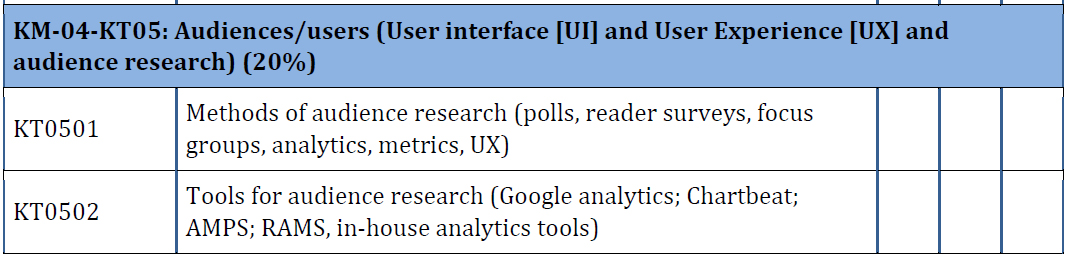
Methods of audience research
Audience research can be conducted in various ways, depending on what you want to find out, or your research question. Some typical methodologies are either quantitative (providing numerical data) or qualitative (providing data in other forms, such as words or descriptions). Both types of data are then analysed. Qualitative data is harder to analyse easily, although depending on the research question, quantitative data may be subject to complex statistical tests to interpret.
It is often difficult and more complex to figure out if something caused another thing to happen, for instance, whether an advertisement caused somebody to visit a website or buy a product because you’d have to, at the very least have to know that someone saw the ad before they engaged in the behaviour. In understanding research, you need to remember that because things occur in a way that makes them seem related, they may not be, or the one may not have caused the other.
These are short multiple-choice questions that often deal with opinions. If short, the response rate can be good. Polls need careful planning to ask questions that are easy to answer for audience members. They can be done repeatedly on different topics. For online, these are virtually free. It is also possible to poll people telephonically or in person. These are more expensive options but these can access a wider distribution of people. Careful poll design and sampling can make the poll results applicable to the whole population or to a certain part thereof.
Some websites (including social media platforms) request readers to react to particular paragraphs in a story or to the story itself. Within the confines of the platform, users can like or dislike content, respond about how it makes them feel or other pre-set responses. This may be difficult to interpret, depending on the approach, but can provide useful information about audiences. They are also not intrusive and allow for information collection without threatening the audiences fearing that their privacy is being infringed upon and can improve the likelihood of social media sharing if well designed.
These are longer questionnaires to get better insight into your audience. Good survey design is essential to get the most information from audiences and frequently these are best outsourced. This means that they can be pricier to conduct than the options above (even online). A good service provider will provide a report with actionable insights based on the survey. They can only be done at wide intervals and should be planned in advance. They can be done over the phone but are cheaper to do online. Too many surveys can annoy audiences.
These are facilitated group discussions around a topic of interest. They allow for in-depth discussion on a topic but are more expensive than surveys per respondent. They are also best outsourced to experts or to a research department. However, they can be done on an ad hoc basis and do not require the lead times and planning that surveys do. Focus groups can be used to inform survey questions.
Analytics from websites or social media platforms provide insight into user behaviour and engagement with content. Analytics require more analysis than is commonly provided by website and social media services and are used to answer specific questions. An expert is often required to interpret the data and provide actionable insights.
Often confused with analytics, metrics are the data readily accessible from websites and social media services and include information about activity, output and others. The most common metrics online are clicks or subscriptions. For other platforms, figures for the number of television viewers or radio listeners are available, as well as ratings of shows or stations. These are available from external companies. For print, circulation figures are available for one’s own publication and competitors. Broadcast, print and online metrics are available from the Audited Bureau of Circulation (ABC).
UX stands for user experience. Studies can be undertaken about the user experience of people accessing your content or services. The approach of these studies varies, they may involve some of the above methods, interviews, eye tracking studies, and many others. Some are very high tech and others are more conventional. They are used prior to or after design. UX studies are essential when launching a new product (such as an app or website) as poor UX means that you may lose your audience members as they get frustrated.
Tools for audience research
There are many tools for audience research including Google Analytics, Chartbeat, Radio Audience Measurement Survey (RAMS), the All Media and Products Survey (AMPS), as well as in-house analytics tools. New services emerge frequently. The wide-scale use of such tools indicates just how important metrics about audiences are to media businesses, advertising departments, editors and journalists themselves. These and other tools can provide information about circulation, websites visitors, social media visitors and others. The kinds of information and their uses will differ between tools.
Advertising and editorial
Traditionally, advertising departments and editorial staff have been strictly separated so as to not corrupt newsrooms with advertising considerations. Advertorials, which look like articles but are actually paid-for content are visually distinguished from news content in print and made clear prior to or after airing in broadcasts. Some advertorials only appear at certain time slots (such as that of home shopping companies).
This has changed somewhat in the current media environment. Now, even traditional news media may include native or content marketing as part of the content they offer. Native advertising is when an advert looks like other articles on the website but is actually paid-for content. Content marketing means access to free content but includes a product or service plug.
Too much content marketing, native advertising and other forms of paid-for content can result in a decline in audience numbers. Sensationalist content may improve advertising revenues but compromise a source’s credibility.
Media managers need to balance such considerations and consider their public service role. As much as metrics may look good, it is possible that the long-term impact of carrying certain content may be negative.


Last modified: Wednesday, 17 May 2023, 3:41 PM